





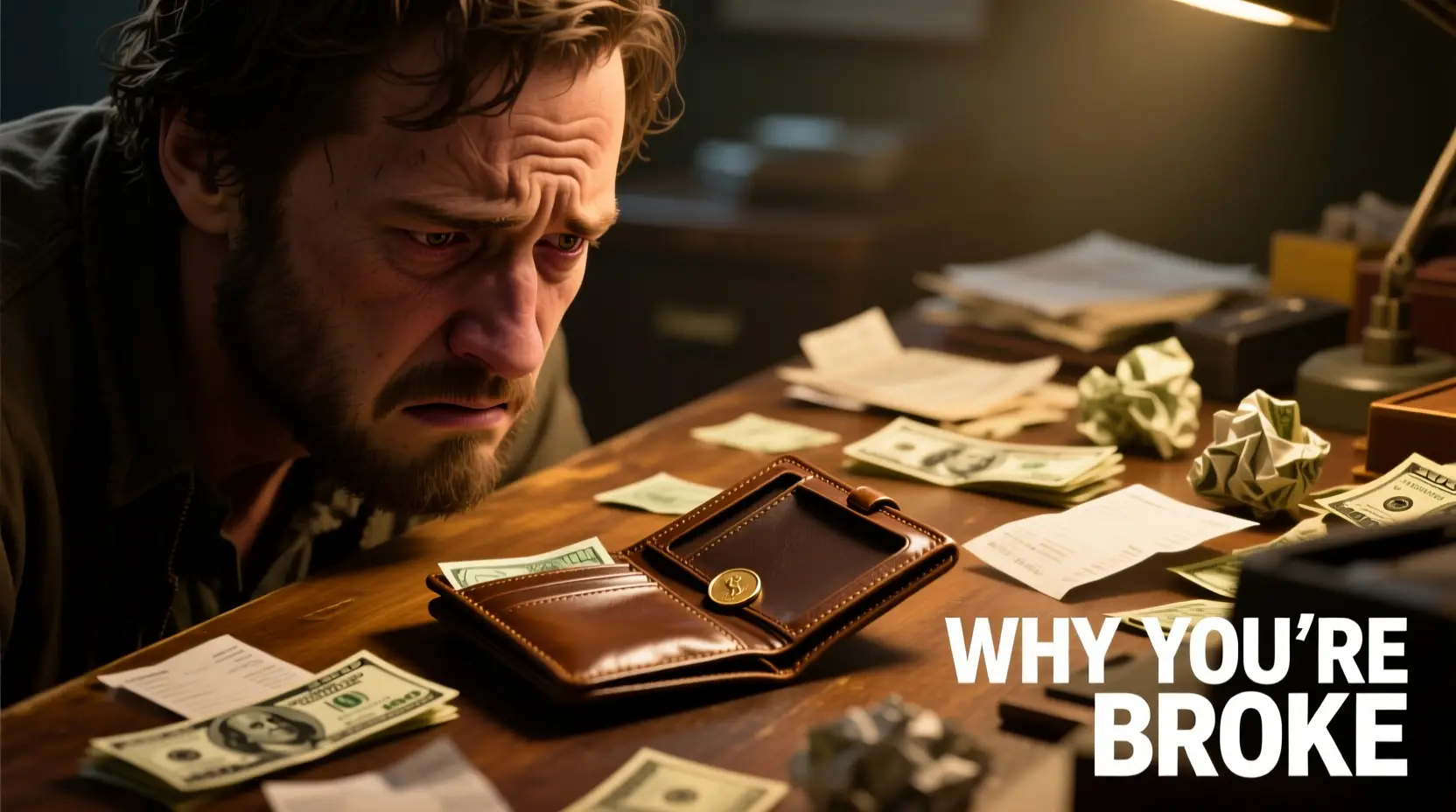
The Invisible Cage: Why Most People Stay Broke
Most people live paycheck to paycheck. It’s a relentless treadmill, a quiet hum of anxiety that starts a few days before payday and only briefly quietens after the deposit hits. They struggle, they stress, juggling bills, praying the car doesn’t break down, and no matter how hard they work—overtime, second jobs, sheer grit—the money never seems to stick. It’s like trying to fill a bucket with a gaping hole in the bottom. You pour and you pour, but the water level never rises.
Why is that? Why do some people seem to effortlessly grow wealth, their money breeding more money in their sleep, while others stay trapped in a cycle of financial struggle their whole lives? We look at them and think it’s magic, or luck, or some secret inheritance. But the answer is simpler, and in many ways, more frustrating than you think: it’s not about how much money you make, it’s about how you think and act around money. The battlefield isn’t the stock market or the real estate office; it’s in the six inches between your ears.
The Scarcity Mindset: The First Trap
First, let’s talk mindset. This is the foundation of everything, the root of the tree. A huge number of people are stuck in what I like to call the scarcity loop. It’s a lens through which they see the entire world of finance. They see money as scarce, fleeting, and almost impossible to hold onto. It’s something that happens to them, a force of nature like a storm or a drought.
When you live in this loop, every expense feels urgent and catastrophic. A $200 car repair isn’t an inconvenience; it’s a crisis that will derail the entire month. Every dollar that comes in feels like it already has a name—the electric company, the landlord, the credit card company. There’s no such thing as “extra” money. And so, when a small windfall does arrive—a tax refund, a bonus, a birthday check—the immediate, almost primal urge is to spend it. To finally buy that thing you’ve been depriving yourself of, to treat yourself because “you deserve it” after all the stress. It’s a pressure-release valve. The money is consumed, and for a brief moment, the stress abates, only to return with the next bill cycle. When you see money as something to be consumed rather than a tool to be cultivated, it slips through your fingers like water.
Wealthy people? They think differently. It’s not that they don’t have problems, but their framework is distinct. They see money as energy. Neutral, fluid energy. It flows in, it flows out, but with intelligence and intention, it can be directed, stored, and multiplied. A dollar isn’t just a dollar; it’s a seed. You can eat the seed today to satisfy your hunger, or you can plant it, water it, and patiently wait for it to grow into a tree that produces more seeds. They aren’t magically immune to stress; they just trade the stress of scarcity for the discipline of growth.
The Compound Effect of Bad Habits
Then comes bad habits. This is where the mindset becomes action. The average person has habits that, by design, guarantee financial struggle. It’s not a single, catastrophic mistake that breaks them. It’s the slow, steady drip of small, self-sabotaging behaviors.
Think about it: buying things they don’t need to impress people they don’t even like. Ignoring bills until the red “OVERDUE” stamp appears, incurring late fees that tighten the vise another turn. Living beyond their means, financing a car payment that strangles their cash flow, or leasing an apartment that consumes 50% of their take-home pay. Then there’s the credit card trap—paying only the minimum, a practice that is like trying to put out a fire with a squirt gun while someone else pours gasoline on it. You’re barely touching the principal, and the interest compounds, turning a manageable debt into a lifelong burden.
These behaviors aren’t accidental. They are patterns, reinforced over years, often learned from well-meaning parents who were stuck in the same cycle. And here’s the kicker that most people miss: bad habits compound just like investments, except in reverse. It’s negative compounding. That daily $5 coffee? It’s not the $5. It’s the $1,825 a year. But more than that, it’s the habit of unconscious spending. That’s the real cost. That $1,825, if invested consistently over 30 years, could grow to over $150,000. The small, repeated financial mistake of buying the coffee isn’t just costing you $5; it’s costing you the future $150,000 that the money could have become. Small leaks don’t just sink ships; they prevent them from ever being built in the first place.
The Comfort of Ignorance: Fear of Learning
Another profound reason most people stay broke is a deep-seated fear of learning. They actively avoid understanding how money works because it feels intimidating, complex, and boring. It’s a form of financial procrastination.
The world of finance is filled with jargon—APRs, ETFs, compound interest, equity, dividends. It can feel like a secret club with its own language, and the gatekeepers seem smug and unhelpful. So, the average person shuts down. Investments? “Too complicated and risky—I might lose everything.” Real estate? “Too much paperwork and liability.” Even creating a simple budget? “Too restrictive and boring. I don’t want to nickel-and-dime myself.”
But avoiding knowledge doesn’t protect you—it keeps you powerless. It leaves you at the mercy of those who do understand the system. You get bad mortgage advice, high-fee investment funds, and predatory loan terms because you don’t have the framework to know any better. The truth is, financial literacy is one of the greatest superpowers you can cultivate in the modern world. It’s the ultimate form of self-defense. And knowledge compounds faster than money itself. Understanding the simple rule of 72 (how long it takes your money to double) or the power of a low-fee index fund can do more for your wealth than a 10% raise. A raise without knowledge just leads to more spending. Knowledge without a raise can still build a fortune.
The Societal Script: Working Hard, Not Smart
Society doesn’t help either. From a young age, we’re handed a script, a life plan that is presented as the only sensible path. We’re taught to work hard, get a good job, be a loyal employee, and save a little for a rainy day. That’s it. The end. The finish line is a gold watch and a pension.
Rarely, if ever, do schools teach the most important lesson: how to make money work for you. We spend years learning calculus and the periodic table, but not a single semester on how to manage personal cash flow, the basics of investing, or how to leverage debt intelligently (yes, some debt can be good!). The system produces excellent workers, not owners. It produces consumers, not creators.
So, most adults graduate, not with a map to financial freedom, but with student debt, a mountain of bills, and a vague sense that they should be frugal. They accept financial struggle as normal, as “just the way it is,” because no one ever showed them a different path. They are following a script written for an economy that no longer exists, where a single income could buy a house and a car and support a family. That script is outdated, and following it blindly is a recipe for staying broke.
The Tyranny of the Now: Instant Gratification
Then there’s the issue of instant gratification. Modern life is a finely tuned engine designed to separate you from your money as quickly and painlessly as possible. Our phones are storefronts. Social media is a relentless parade of influencers showcasing new gadgets, fashion trends, and luxurious vacations, creating a constant sense of “FOMO”—fear of missing out.
It’s the fancy coffee, the subscription boxes for everything from socks to snacks, the one-click “Buy Now” buttons, the endless scroll of targeted ads that know your desires better than you do. Every notification, every swipe, is a potential purchase. This environment trains us to seek immediate emotional rewards through spending. Feeling sad? A little retail therapy will cheer you up. Had a hard day? You deserve that expensive dinner.
Wealthy people delay gratification. This is a muscle they have trained. It’s not that they never enjoy their money; they absolutely do. But they spend intentionally, on things that bring them genuine value and joy, after their wealth-building goals are met. They understand that real financial freedom comes from planting seeds now—seeds that feel boring and insignificant—and letting them grow into a forest that will provide shade for decades. They trade the thrill of a new pair of shoes today for the profound peace of mind that comes from a robust investment account tomorrow. They ask not “Can I afford the monthly payment?” but “Is this the best use of this capital for my long-term goals?”
The Paralysis of Perfection: Fear of Failure
Finally, fear of failure keeps people stuck, frozen in place. Taking financial risks—even small, calculated ones—is terrifying. The thought of starting a side hustle brings visions of wasted time and public embarrassment. Investing in stocks conjures images of the 2008 crash and losing your life savings. Launching a business feels like a high-wire act with no safety net.
So, most people avoid it. They choose the perceived safety of the known struggle over the uncertain promise of growth. They stay in the mediocre job with the steady paycheck, even if it’s slowly suffocating their spirit. They keep their “safe” money in a savings account earning 0.01% interest, watching inflation silently eat away at its value year after year.
Ironically, this “safe” path often costs more than taking calculated risks. The cost of inaction is invisible, but it’s staggering. It’s the cost of missed opportunities, of a retirement spent in anxiety, of never having the freedom to choose how you spend your time. The cycle is self-perpetuating: no risk, no growth, perpetual financial stagnation. You become a prisoner of your own paycheck.
Breaking the Cycle: You Hold the Key
So, why do most people stay broke? It’s a perfect storm. It’s the mindset traps that color your perception, the poor habits that drain your resources daily, the fear of learning that keeps you powerless, the siren song of instant gratification that pulls you off course, and a society that rewards conformity over financial creativity.
But here’s the good news, the powerful, life-changing good news: none of these are permanent. They are not life sentences. They are software installed in your brain, and software can be updated. You can break the cycle. You have the power to retrain your brain to see money not as a villain or a temporary visitor, but as a powerful, neutral tool. You can adopt new habits, one by one, that grow wealth instead of drain it—habits that compound in your favor. You can decide, today, to educate yourself, to embrace the beginner’s mind, to start with one book, one podcast, one article. You can learn to embrace smart, calculated risks, understanding that a small failure is just tuition for a valuable lesson.
Wealth is not a mystery reserved for a lucky few. It’s not a secret code. It’s a combination of knowledge, discipline, and mindset. It’s a practice. Change those, and you change your financial future. You move from being a passive consumer of life, buffeted by every financial wind, to an intentional creator of your own destiny. You stop filling the leaky bucket and start building an aqueduct. The journey of a thousand miles begins with a single step. Your future self is waiting, and they will thank you for the courage you show today.