







Your Financial Blueprint: A Step-by-Step Guide for Teens to Build Wealth
Let’s be honest: most of what you hear about money is either too complicated, incredibly boring, or comes from people who don’t actually have any. What if you had a real, step-by-step plan to follow? A plan that, if you started young, could very well set you on the path to becoming a future millionaire.
That’s what this is.
I managed to become a millionaire in my 20s, but I can tell you with absolute certainty that if I had seen a guide like this when I was 13, I would have reached my goals much, much faster. This isn’t about get-rich-quick schemes; it’s about building a foundation of habits and knowledge that compound over time, just like money itself.
Whether you’re 13, 18, or older and using this as a checklist, I promise that implementing even a few of these steps will put you so far ahead of your peers, it will feel like you’re playing a different game entirely. Don’t just skip to your current age. The power is in the sequence. Each step builds on the last, and skipping one could leave a gap in your financial foundation you’ll regret later.
Ready to take control? Let’s start at the very beginning.
Age 13: The Unfair Advantage of Time
When it comes to investing, there is one factor that is more powerful than any stock tip, any market prediction, or any amount of genius-level analysis. That factor is time.
But what does “time in the market” actually mean? Imagine a tiny snowball at the top of a very large hill. You give it a gentle push. At first, it doesn’t seem to pick up much snow or speed. But as it continues its journey, it grows larger and faster, gathering an immense amount of snow until it becomes an unstoppable avalanche. Your money works the same way. The earlier you start, the longer it has to roll down that hill, and the more massive it can become.
If you are 13 or younger reading this, you are in the most enviable position possible. You have a resource that those of us in our 20s, 30s, and beyond can never get back: decades of compounding growth ahead of you.
So, how do you actually start investing when you’re not legally old enough to open your own account? You need to have a conversation with a parent or guardian about opening a custodial account.
I understand this can feel daunting. My family never spoke about money, let alone investing. It was a complete mystery. If you need a little help starting that conversation, feel free to share this section with them.
A Quick Word for Parents & Guardians
A custodial account is an investment account controlled by an adult for the benefit of a minor. It’s a powerful tool to give a young person a monumental head start. The specific names vary by country:
- In the UK, it’s called a Junior Stocks and Shares ISA. A parent or guardian can invest up to £9,000 per year on the child’s behalf. The child can start managing it themselves at 16, and access the funds at 18.
- In the USA, the main options are UGMA or UTMA accounts. These have unlimited contributions, though large sums could trigger gift tax considerations. The key difference is that UTMAs can hold a wider range of assets, including real estate and art.
You can set these up with most major banks or brokerages. My personal preference is Vanguard for both the UK and USA due to their long history and notoriously low fees, which means more of the money’s growth goes to the investor.
Now, what should go inside this account? I am not a financial advisor, and this is not financial advice. However, a strategy I’ve used and that is recommended by countless experts is to invest in a simple, low-cost S&P 500 index fund. This is a single investment that spreads your money across the 500 largest public companies in the United States. You get instant diversification without the risk and stress of trying to pick individual winning stocks.
The historical average annual return of the S&P 500 has been around 10-11% over the long term. Of course, past performance doesn’t guarantee future results, and investments can go down as well as up. But by capturing the growth of the entire American economy, you’re setting yourself up for long-term success.
So, if you take away one thing from this section, let it be this: please, talk to your parents about setting up one of these accounts. It is, without a doubt, the single greatest financial head start you can possibly get.
Age 14: The Laboratory of Life
At 14, you possess another incredible advantage beyond just time: freedom from major financial obligations. You likely don’t have to pay rent, a mortgage, or utility bills. This creates a unique laboratory where you can experiment with making money without the pressure of it being your only lifeline.
This is your time to try everything. I mean it. Pressure wash driveways, walk dogs, try competitive sports, learn a musical instrument, create art, or code a simple website. The goal isn’t necessarily to build a sustainable business immediately; it’s to explore.
You will learn something from every single endeavour. My son, Curtis, used to wake up for swimming practice at 4:00 a.m. most mornings. He didn’t earn a penny from it, but it instilled in him a level of discipline and work ethic that, when he started his own business at 18, allowed him to effortlessly outwork his competition.
I often speak with teenagers who tell me, “I don’t have a talent.” But when I ask them what hobbies they’ve seriously tried, they draw a blank. You cannot expect to discover a hidden talent or passion if you haven’t sampled what the world has to offer.
The strategy is simple: Try. Everything. If something doesn’t stick, that’s not a failure—it’s a data point. You’ve learned what you don’t enjoy. Cross it off the list and move to the next thing. When you finally stumble upon something that you’re naturally good at, or, more importantly, that you enjoy getting better at, that’s your signal. Double down on it. Immerse yourself. Make it your mission to become exceptionally skilled in that area.
Age 15: The Art of the Stash
Let’s talk about a bittersweet reality of growing up: the slow decline of birthday and Christmas presents. It’s not that people stop caring, but the scale and frequency often change, especially for young men. This presents a huge opportunity.
Instead of asking for the latest video game or trendy clothing—items you’ll likely lose interest in within a few months—adopt a life hack: ask for cash whenever possible.
Combine this with getting a Saturday or weekend job. Don’t be picky at this stage. Even a job behind a counter in a retail store does two critical things: it earns you a stream of cash, and it teaches you invaluable social and customer service skills that prepare you for the “real world.”
Doing both of these things will help you start building a cash reserve, but only if you can resist the immediate temptation to spend it. This is where I have an issue with the traditional concept of “saving.” Many teenagers will “save” for months, only to blow the entire amount on a new console or a day out. While you should absolutely spend some of your money to have fun and enjoy being young, your core reserve should be viewed differently.
I prefer the word “stash.”
Think of your stash not as a spending fund, but as a launch pad. It is the capital you will use to make even more money in the future. The hardest thing in the world is to start from absolute zero. If you can avoid that—if you can enter your next phase of life with even $100, $500, or $1,000 saved—everything becomes exponentially easier. You have options. You can invest in tools, take a calculated risk, or handle an emergency without panic.
One final, practical tip for this age: if you’re in the UK, go and apply for your provisional driving licence. You can do this from 15 years and nine months. Get the bureaucratic step out of the way early, even if you don’t plan on driving immediately.
Age 16: The Skill Stacker
You now have a two-year window before the training wheels officially come off. This is the time to move from exploration to focused development. By now, if you’ve followed the previous steps, you should have a handful of things you’re reasonably good at or interested in.
These skills might seem unrelated. Maybe you’re good at selling, you enjoy graphic design, and you tinker with mechanics. It may feel like a random collection, but your next task is to start stacking these skills on top of each other.
When I was younger, my own “stack” included selling, design, and woodwork. I invested my money in tools and resources to get better at each of them, trusting that eventually, they would connect in a useful way. And they did.
I’m not necessarily talking about buying expensive online courses. The internet is full of “gurus” more interested in selling you a dream than providing real value. While good educational resources exist, a better investment is often in equipment and community.
I remember when my son used his stashed cash to buy his first iMac from his uncle for $500. Because it was the most significant purchase he had ever made, he was determined to extract every ounce of value from it. He spent countless hours teaching himself video editing and Photoshop on that machine. That single investment in a tool opened numerous doors for him.
Between 16 and 18, your primary goal should be to develop a suite of tangible skills. This allows you to enter the adult world with actual value to offer. For an employer, hiring someone who already has relevant skills is a much lighter burden, as it drastically cuts down on training time. You become an asset on day one, not a project.
Age 17: The Key to Freedom
Listen very carefully. This is non-negotiable: You need to pass your driving test.
I know it might seem like you don’t need to drive right now. Your friends might not be doing it, and your parents can still give you lifts. But trust me, the sooner you get this done, the better. In some US states, you can start at 16. Remember, you only have to do it once.
Not being able to drive is one of the single biggest barriers holding people back from starting a side hustle or seizing opportunities. Imagine a potential client offers you a fantastic gig, but they live 30 minutes away. Without a licence, you’re at the mercy of public transport or the availability of others. This unreliability can make you seem unprofessional before you even start, and the opportunity will vanish.
One of my core principles to this day is this: To be early is to be on time. To be on time is to be late. And to be late is unacceptable. A driver’s licence is a fundamental tool for upholding that principle.
Yes, learning to drive can be intimidating for some (I found it thrilling), but you must think about the bigger picture. Once you have your licence, you can use a portion of your “stash” to buy a cheap, reliable starter car. Suddenly, nothing is holding you back. Your radius of opportunity expands from your immediate neighbourhood to your entire city and beyond.
Age 18: The Launchpad – Your 7-Point Checklist
Congratulations, you’re officially an adult. The training wheels are off, and the world is yours to shape. I wish someone had sat me down on my 18th birthday with a clear, actionable checklist. Since I didn’t have that, I’ve created one for you.
Here are the seven things you need to do as soon as possible after turning 18 to set yourself up for long-term success. If you’re older, use this as a audit to ensure you’re on track.
1. Open Your Own Bank Accounts
This is your first logical step into financial independence. I say “accounts” plural because you should have two, ideally at separate banks to create a psychological barrier against spending your savings.
- A Current Account (Checking Account in the US): This is your operational hub. Your salary from a job, payments from side hustles, and any other income flows in here. You then use this account for your daily spending.
- A High-Interest Savings Account: This is your financial airbag. Your goal is to build an emergency fund here that covers 3 to 6 months of essential living expenses. This money is for true emergencies—like if you lose your income—so it’s not to be touched otherwise. The “high-interest” part means your money earns a small return while it sits there, fighting inflation.
Look for banks with minimal or no fees. Your money should be working for you, not being eroded by charges. In the UK, challenger banks like Monzo are excellent for current accounts, while Chase often offers competitive savings rates. In the US, consider online-focused banks like Ally or established players like Bank of America for their widespread services.
2. Get a Credit Card (The Right Way)
This is often the most misunderstood piece of advice. I was taught, “Never a lender or a borrower be.” It turns out, that’s a saying that has historically been used to keep people from building wealth. To have a good financial future, you need a good credit score. Think of it as your financial report card.
The safest and most effective way to build credit is to get a credit card and use it responsibly. Here’s the golden rule: Only use it for purchases you can already afford with the cash in your current account, and pay off the balance in full, every single month, without fail.
Use it for your petrol, your groceries, or a monthly subscription. Then, when the statement arrives, pay the entire amount. By doing this, you prove to lenders that you are reliable, and you will never pay a penny in interest. A strong credit score is crucial for getting approved for a mortgage, a business loan, or even renting an apartment, and it will secure you the best possible interest rates, saving you tens of thousands of pounds or dollars over your lifetime.
3. Open an Investment Account
Now that you’re 18, you can open your own investment account. The key is to open the correct type of account—one with significant tax advantages. You’ve likely heard the terms:
- Roth IRA (USA)
- Stocks and Shares ISA (UK)
- TFSA (Canada)
- Superannuation (Australia)
These accounts are powerful because they allow your investments to grow completely free of taxes on capital gains or dividends, supercharging your compounding. They do have annual contribution limits, but you should strive to use them.
The process is now simpler than ever, with user-friendly apps. A fantastic feature many offer is fractional shares. Instead of needing hundreds of pounds or dollars to buy a single share of a company like Amazon or Apple, you can invest as little as £1 or $1. This democratizes investing, allowing you to build a diversified portfolio with small, regular contributions.
Many of these platforms also offer “practice” modes with virtual money, which is an excellent, risk-free way to learn how the markets work before committing real capital.
4. Carefully Consider University
“Is university a scam?” It’s a question I’m asked constantly. My answer is always nuanced: yes and no.
- No, it’s not a scam for career paths that require a specific, accredited degree. If you want to be a doctor, a nurse, an engineer, or a teacher, university is a necessary and valuable gateway. These professions are the backbone of society.
- Yes, it can be a scam if you’re going for the wrong reasons. If you feel pressured into attending, are studying a vague subject with no clear career path, or are taking on £60,000 of debt for a degree in “Golf Management” (a real degree, by the way), you need to think very carefully.
For many high-income skills in trades, tech, and entrepreneurship, what matters is your competence, your portfolio, and your track record—not a piece of paper. I’ve had countless people comment that they learned more about business from practical resources than from their entire business degree.
If you’re unsure, a powerful alternative is an apprenticeship. You earn a wage while you learn a skilled trade, graduating with valuable experience and no debt. It’s a win-win. Don’t let social pressure dictate a decision that could saddle you with a lifetime of debt.
5. Understand Good Debt vs. Bad Debt
Debt is a tool. And like any tool, it can be used to build something magnificent or it can cause serious damage.
- Good Debt (Weaponised Leverage): This is debt used to acquire an appreciating asset—something that increases in value over time. A mortgage is the classic example. You borrow money to buy a house, which historically increases in value, while you also build equity. Debt used to start or scale a business is another form of good debt, as it can generate future profits.
- Bad Debt (The Anchor): This is consumer debt. It’s money borrowed to buy things that lose value immediately and provide no return. Financing a brand-new car (which depreciates the moment you drive it off the lot), running up credit card bills on holidays, clothes, or expensive dinners—this is the debt that becomes a heavy anchor, dragging down your financial progress. The rule is simple: if you can’t afford to buy it outright with cash, and it’s not going to make you money or become more valuable, you cannot afford it.
6. Start a Service-Based Side Hustle
The old-fashioned advice is to “go get a job,” often implying a life of quiet desperation. It doesn’t have to be that way. By now, you should have been developing valuable skills. It’s time to monetize them.
A service-based side hustle is the perfect starting point. It requires very little startup capital—just your expertise. Think about:
- Copywriting
- Video Editing
- Social Media Management
- Web Development
- Graphic Design
If you don’t have a marketable skill yet, it’s time to catch up fast. Use any “day job” you have as a learning platform. Learn the soft skills, save the money, and use it as fuel. Start viewing every shift not as a grind, but as an investment in your future freedom. The money you earn and the discipline you learn become the launch pad for your own ventures.
7. Invest for the Long Term and Harness Compound Interest
We end where we began, by harnessing the most powerful force in finance: compound interest.
This is the phenomenon where you earn returns not only on your original investment but also on the accumulated returns from previous periods. It’s the snowball rolling down the hill, gathering more snow with each revolution.
Let’s illustrate its staggering power with an example:
- Investor A starts at age 18, investing $250/£200 per month into a tax-advantaged account. Assuming an average annual return of 8%, by the age of 65, their portfolio would be worth approximately $1.5 million.*
- Investor B does the same thing but waits just 10 years, starting at age 28. By 65, their portfolio would only be worth around $679,000.*
That 10-year delay costs over $800,000. The extra decade of compounding for Investor A creates a massive difference because their money has more time to work. Starting young means you need to contribute less money overall to reach the same goal, and you’ll typically be in a lower tax bracket, meaning you keep more of what you earn.
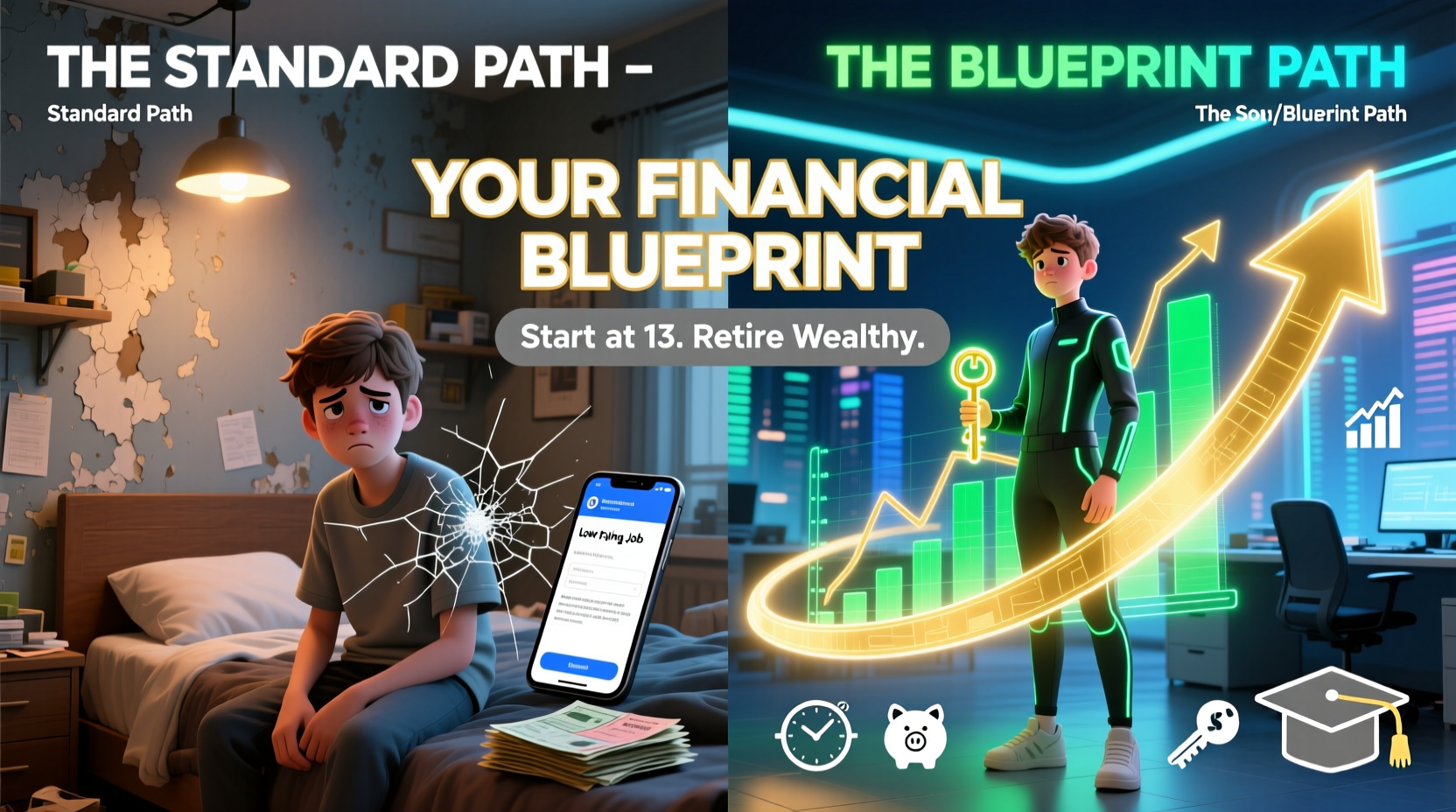
This is your blueprint. This is your path. It requires discipline, patience, and a willingness to think differently from the crowd. But if you follow these steps, you won’t just be watching from the sidelines as others build wealth. You’ll be actively constructing your own financial future, one smart decision at a time.