







Navigating the Storm: How Geopolitical Tremors and Market Volatility Could Define Your Financial Future
It’s no secret that the financial landscape feels particularly fragile right now. If you’re not prepared, the coming months have the potential to either make or cost you a significant amount of money.
Consider the current climate: we’re grappling with the threat of a government shutdown, persistent global turmoil, and whispers of a monumental $37 trillion financial reset. And now, after months of seemingly non-stop profits, we’ve just witnessed a dramatic wake-up call. The markets experienced their worst single-day point drop since the April sell-off, while the cryptocurrency space saw the largest one-day liquidation event in its entire history.
The catalyst? A single word that sends a chill down the spine of every investor: China.
Despite reassuring headlines suggesting that everything is fine, rest assured, there is much more happening beneath the surface than the average person realizes. With stock valuations sitting at some of the most expensive levels ever recorded, it’s crucial to understand exactly what’s unfolding. Let’s break down the situation, its implications for your portfolio, the widespread impact we can expect, and finally, how you can position yourself to not just survive, but thrive. The road ahead may be bumpy, but knowledge is your most powerful asset.
The Chessboard of Global Trade: A Complicated Relationship
To understand the current volatility, we must start with the complex relationship between the U.S. and China. It’s a classic case of economic codependency. The United States relies on China for low-priced goods that are significantly cheaper than what we can manufacture domestically. In turn, China depends on our massive consumer market to buy those goods, a critical pillar supporting their economic engine.
However, this relationship is built on a fundamental imbalance: a massive trade deficit. Simply put, we buy far more from them than they buy from us. Many economists and policymakers view this deficit as a structural risk, not just to American manufacturing, but to our long-term economic strength and even national security.
This is why, earlier this year, the Trump administration enacted a series of global tariffs, aiming to incentivize and bring manufacturing back to U.S. soil. China, as expected, did not take this lying down. They retaliated with their own tariffs. The U.S. responded by issuing even higher tariffs against Chinese goods. This tit-for-tat escalation spiraled quickly, triggering one of the most severe stock market drops since the Great Depression.
Thankfully, a temporary truce was reached. The market breathed a sigh of relief and soared to new all-time highs, leading many to believe the trade war was behind us. But as we’ve learned, in geopolitics, “quiet” is often just the calm before the storm.
The Rare Earth Gambit: A Strategic Move in the Trade War
The tension resurfaced dramatically on Thursday, October 9th. China announced it would be implementing stringent export controls on rare earth minerals. If that sounds like an obscure technicality, think again. These elements are the unsung heroes of modern technology, found in almost everything we use daily—from smartphones and electric vehicles to advanced military hardware.
The strategic nature of this move becomes starkly clear when you learn that approximately 90% of the world’s rare earth minerals are processed within China.
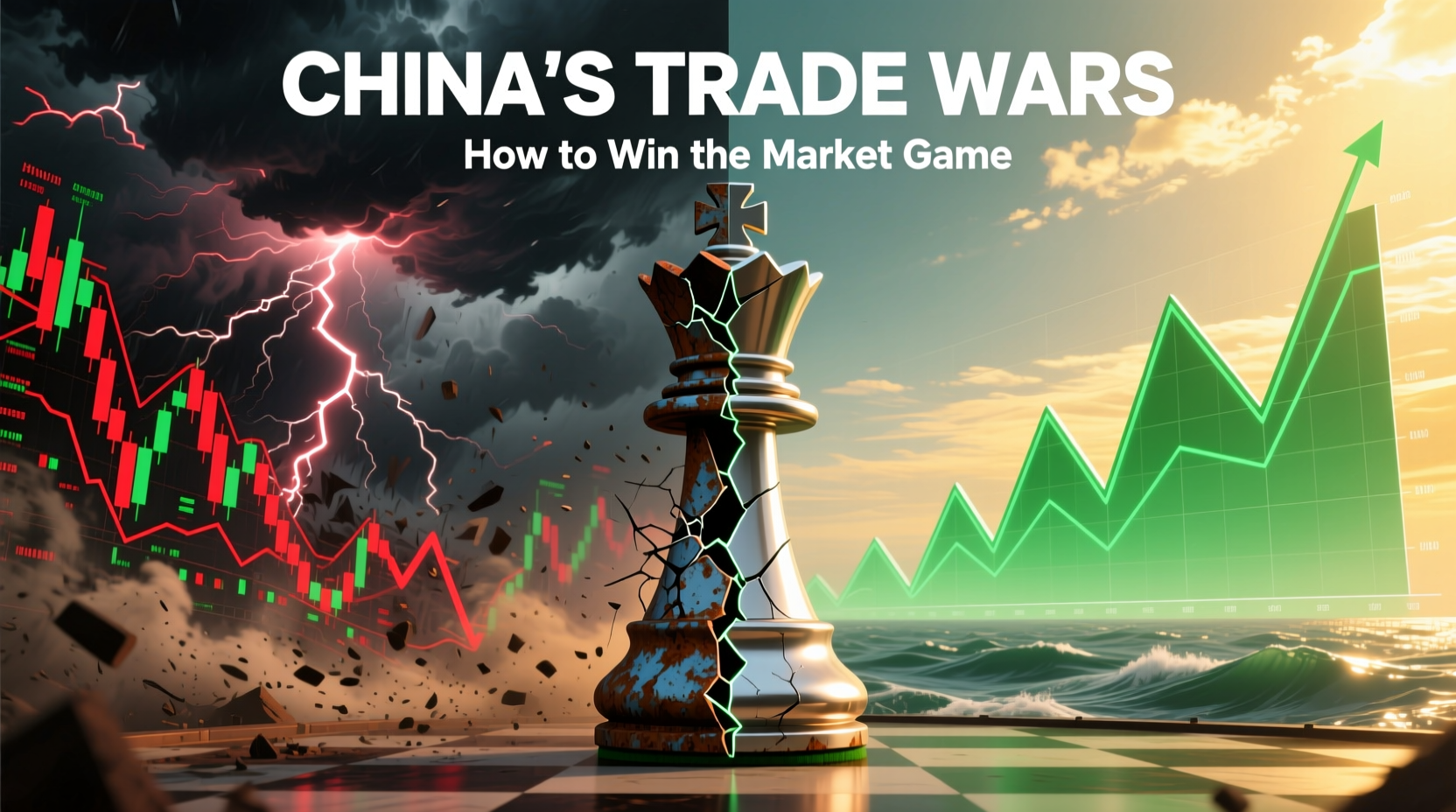
Officially, China’s ministry stated that these controls are an “international practice” due to the minerals’ “dual-use” properties for both civilian and military applications. But let’s be realistic: this is a masterful negotiation tactic, a direct response to the escalating tariff tensions from April. It’s a high-stakes chess move designed to weaken our position after we attempted to weaken theirs.
The U.S. response was swift and forceful. On the following Friday, President Trump announced an additional 100% tariff on Chinese goods, coupled with new export controls on critical software, set to take effect November 1st.
Then, in a dizzying pivot over the weekend, China seemed to backpedal, suggesting the entire situation was a “big misunderstanding.” President Trump echoed this conciliatory tone, stating that China’s president “just had a bad moment” and that everything would be fine. The markets, desperate for any sign of stability, rallied as if the crisis had never occurred—even though the plan for 100% tariffs on November 1st was still actively being tweeted about.
This rollercoaster highlights a disturbing reality of our modern economy: the fate of global markets can hinge on a single social media post.
A Market on Borrowed Time: The Catalyst for a Sell-Off
While the China news was the immediate trigger, the soil for a sell-off had been fertile for some time. Up until this point, we had witnessed one of the strongest six-month market rallies in history. From my perspective, the market was climbing so relentlessly that a sense of unease began to creep in. Investors were quietly questioning whether such gains were sustainable.
For example, last week, online search volume for “AI bubble” hit a record high. A growing number of investors felt the economy was on borrowed time. Prominent billionaire investor Paul Tudor Jones went so far as to say the market euphoria was reminiscent of the period immediately preceding the 2001 dot-com crash.
Adding to the concerns, credit scores were reported to be dropping at the fastest pace since the Great Recession. Private credit was drying up, and anecdotally, I noticed more and more investors pulling back, building up cash reserves, and preparing “dry powder” for a potential downturn.
Even for someone like me, who practices dollar-cost averaging religiously, it has become increasingly difficult to justify some of the recent market valuations. Consider this: the technology sector now comprises a larger share of the S&P 500 than it did at the peak of the dot-com bubble. The top 10 companies in the index make up over 40% of its total weight. Furthermore, the Buffett Indicator—which compares the total stock market valuation to GDP—recently hit its highest level ever recorded, implying that this is one of the most expensive stock markets in history according to that metric.
I share all this to make a simple point: from my observation, devoid of complex charts, the stock market appeared to be operating on borrowed time, simply waiting for a reason to correct. The China trade drama provided that catalyst, prompting investors to hit the eject button—especially since we hadn’t seen a 2% decline in over six months.
The Crypto Liquidation Cascade: When Leverage Meets Panic
If the stock market sell-off was sharp, the reaction in the cryptocurrency world was nothing short of violent. Believe it or not, in less than 30 minutes, the digital asset space experienced the largest single-day liquidation in its history. Bitcoin printed its first-ever $20,000 red candlestick on some charts, and countless leverage traders saw their fortunes evaporate almost instantly.
Why was the reaction so extreme?
Beyond the obvious factors of panic selling and allegations of large-scale price manipulation, the secret lies in a little-understood term outside of crypto circles: leverage.
On some platforms, traders were able to employ leverage as high as 100x. This means that with just $1 of their own capital, they could control and profit from $100 worth of Bitcoin. To put it simply, if the price moved up by just 1%, they would double their money. But the flip side is catastrophic: if the price moved down by just 1%, their entire position would be wiped out, or liquidated.
This creates a vicious, self-reinforcing cycle. It’s speculated that a significant portion of the market’s rise was propped up by these highly leveraged trades. So, when prices began to fall, it triggered a wave of automatic liquidations. These forced sales pushed prices down further, which triggered even more liquidations, accelerating the downward spiral. In a matter of minutes, a cascade of selling wiped out a tremendous amount of capital.
Thankfully, despite the ferocity of the drop, which was largely contained to about an hour, both Bitcoin and the stock market have, for now, found a footing around levels seen a month ago. We’ve essentially given up a month’s worth of gains. While watching a month of progress vanish in an hour is unsettling, it’s crucial to maintain perspective. Not all hope is lost; in fact, such volatility often creates profound opportunities for those who are prepared.
The Unshakeable Investor: A Philosophy for Turbulent Times
In moments like these, when headlines are dominated by chaos and portfolio values are swinging, it’s more important than ever to return to first principles. My own investment philosophy is built on a few core tenets that have proven resilient through multiple cycles.
1. There Will Always Be a Reason for Pessimism.
When I first started buying real estate in 2011, the market had already crashed by 50%. The prevailing wisdom was that it was a terrible time to buy; people warned of “shadow inventory” that would cause prices to plummet further. I’m thankful I didn’t listen, as those properties have since quadrupled in value. The same narrative emerged in 2017 when I discussed investing in the S&P 500—many declared it overvalued and destined for a crash. Those who held are now up significantly. This pattern repeated in 2020, 2022, and again earlier this year. There will always be a compelling reason not to invest. The key is to focus on the long-term signal through the short-term noise.
2. Investing is Inherently Boring.
Let’s be honest: successful investing is not a thrilling game. It shouldn’t be a source of constant excitement. While I personally find the markets fascinating, the act of investing itself should be methodical and, frankly, dull. If you’re posting screenshots of your weekly gains on social media, you’re likely taking on far too much risk. The line between taking a calculated investment risk and outright gambling has become dangerously blurred for many.
3. Overconfidence is Your Portfolio’s Greatest Enemy.
Paradoxically, the less you think you know, the better you will often perform. This is because you’re less likely to overcomplicate your strategy or attempt to outsmart the market. Study after study confirms that the most successful investors are often those who simply buy a broad-based index fund and hold it for decades. It’s a simple, powerful strategy that few follow because it lacks the allure of a “get rich quick” scheme. Over the span of decades, however, those who chase excitement often look back with regret, wishing they had embraced simplicity.
4. Prepare for a Deeper Drop Than You Expect.
An actual market correction is almost always more psychologically painful than you can imagine. It’s easy to see a 5% dip as a buying opportunity, only to watch it fall 10%, then 15%, then 20%. It’s a process that often exhausts investors’ cash and resolve. Historically, the true market bottom forms at a point of absolute investor capitulation—when the prevailing sentiment is that the market is doomed forever and will never recover. That moment of peak pessimism is usually the best time to buy. This was the case in 2008, 2020, and 2022. Every investor faces a “this time is different” moment; your ability to stay the course through it will define your long-term outcomes.
5. Cultivate Good Financial Habits in All Seasons.
The principles of sound financial health—diligent saving, boring investing, and living below your means—may not be glamorous, but they are your anchor in a storm. I’ve always prioritized a conservative approach and a degree of frugality, not out of fear, but out of respect for the unpredictable nature of the economy. I’ve seen too many careers, businesses, and portfolios evaporate to believe it can’t happen to anyone. This mindset allows me to sleep soundly at night, knowing that even in a severe downturn, my financial foundation is secure.
The Power of Staying the Course: What the Data Tells Us
Emotion is a poor guide for investment decisions. Data, however, provides a much clearer picture. Consider these historical insights:
- Missed Opportunities: A stunning statistic reveals that half of the S&P 500’s strongest performing days over the past two decades occurred during a bear market. Another 34% of the market’s best days took place in the first two months of a new bull market, before it was even clear that the downturn had ended. This is critically important. If you had simply missed the top 10 best trading days over the last five years, your annualized return could drop from a potential 15% to a meager 3.75%.
- Volatility is the Norm, Not the Exception: Since 1920, the S&P 500 has experienced an average of three 5% pullbacks every single year. What we’ve just witnessed isn’t even a blip on the historical radar. Furthermore, since the 1940s, there have been nearly 50 market corrections of at least 10%, which averages out to one about every 20 months.
- “Average” Returns are Rare: When you look at the long-term average stock market return, it’s vital to understand that you almost never get the “average” return in any given year. A blog called “A Wealth of Common Sense” highlighted that since 1926, the market has only returned between 8% and 12% in a year a mere five times. An 8-12% return is just as likely as the market shooting up 40% or more. In fact, only 12% of annual returns fall within the 5-15% band. It is far more common to experience double-digit gains or losses than a return that hugs the long-term average.
This data tells a compelling story: successful investing requires a time horizon of decades, not weeks or months. If you are going to participate in the market, you must become accustomed to seeing significant paper losses along the way. It is an inherent part of the journey.
My Approach: Tuning Out the Noise
So, where does this leave us today? To me, the current headlines are just market noise. While I find it fascinating to analyze the “why” behind market movements, it does not dictate my investment strategy. Yes, I have concerns about elevated valuations, but I also respect the old adage: “The market can remain irrational longer than you can remain solvent.” The market could very well continue its climb for some time before any significant correction occurs. I have no interest in trying to time it.
I also keep in mind that we are not even halfway through what would be considered an average bear market, should one begin. The market’s recent recovery demonstrates its ability to digest information and move on.
One astute observation that resonated with me came from “The Cobassy Letter,” which perfectly broke down the recent negotiation pattern: Make a cryptic post, announce a large tariff right before the weekend, watch money pour in to buy the dip, de-escalate the situation over the weekend, announce a solution is in the works, and witness a full recovery within days. It’s a cycle we may see repeated. And on a more macro level, there are even theories about a $37 trillion debt reset plan involving gold and cryptocurrency. The truth is, in this environment, anything can happen with little warning.
That is precisely why I am staying the course. My plan remains unchanged: continue with my regular investment schedule, maintain a slightly larger cash position on the sidelines to seize any significant buying opportunities that may arise, and focus on the long-term horizon. The recent volatility is a reminder of the market’s inherent unpredictability, but for the disciplined investor, it is not a reason to retreat—it is a call to remember the fundamentals.