







The Oracle Shifts His Gaze: Warren Buffett’s Stark Warning for the Housing Market
For decades, investors around the world have hung on every word from Warren Buffett. His folksy wisdom and unparalleled track record have made his annual shareholder meetings something of a financial holy grail for those seeking direction. So, when the Oracle of Omaha issues a warning, it’s not just news—it’s a potential roadmap for preserving and growing your wealth.
What makes this latest development so compelling is the complete reversal of a stance he held for years. Back in 2012, in the aftermath of the Great Financial Crisis, Buffett famously declared that if it were practical, he’d “buy up a couple hundred thousand single-family homes.” He argued that, when financed with low-rate, long-term mortgages, housing could be a phenomenal investment, even surpassing stocks.
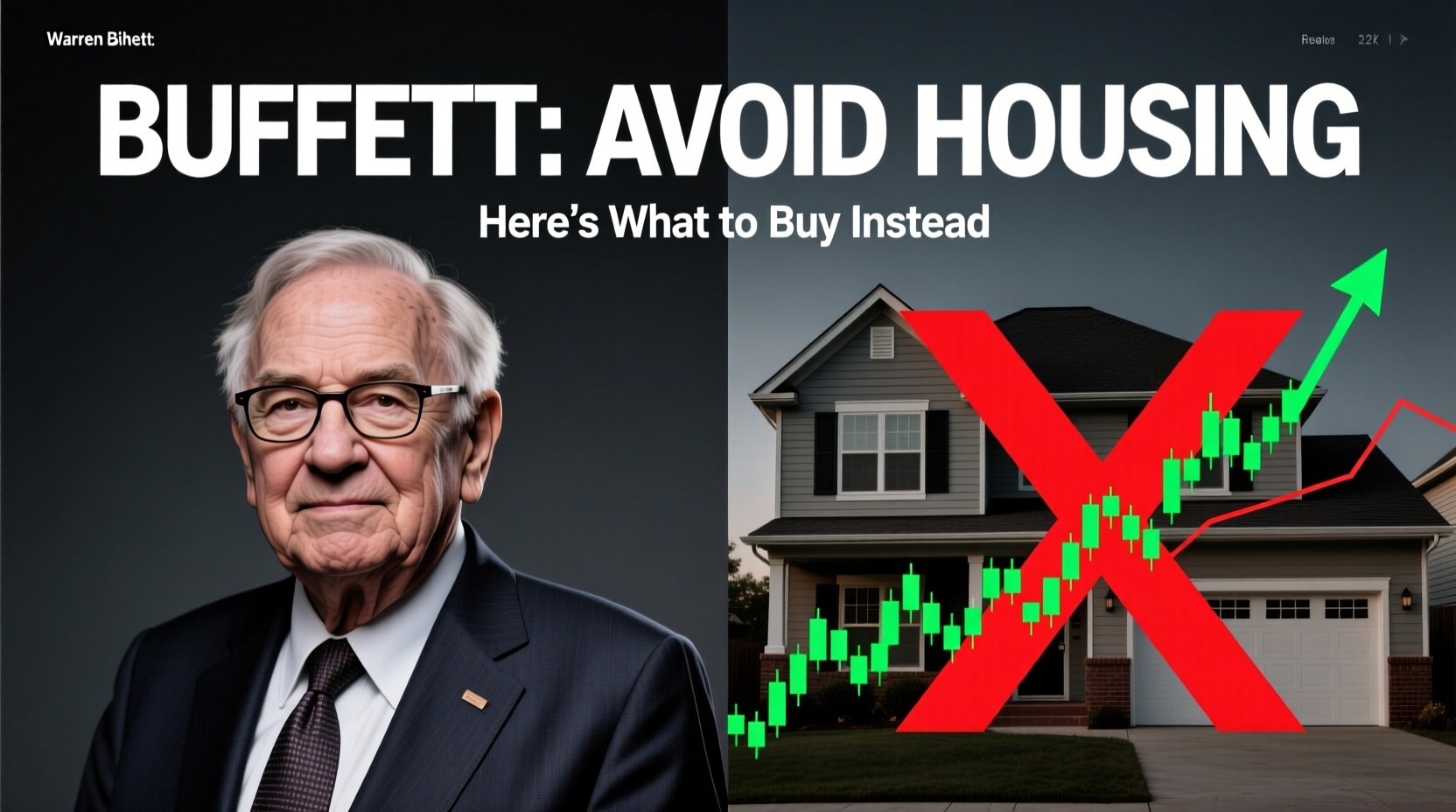
Today, the tune has changed dramatically. During his most recent commentary, Buffett delivered a sobering message: he no longer sees real estate as an attractive investment. This isn’t a casual observation; it’s a fundamental shift in perspective from one of history’s most successful capital allocators. For anyone with a stake in the housing market—whether as a homeowner, a prospective buyer, or an investor—understanding his reasoning is crucial. It might just be the insight that saves you from a significant financial misstep.
From Bull to Bear: Buffett’s Changing Perspective on Real Estate
To appreciate the gravity of this shift, we need to revisit his previous optimism. In the depths of the housing crash, Buffett saw immense value. Prices had collapsed, and borrowing costs were at historic lows. This created a perfect storm of opportunity where the intrinsic value of a tangible asset—a home—could be harnessed with cheap debt. His logic was sound: lock in a 3% mortgage for 30 years on an undervalued asset, and time would almost certainly work in your favor.
Now, the landscape is unrecognizable. The median home price in the United States has soared to new all-time highs, and the era of 3% mortgages is firmly in the rearview mirror, replaced by rates that have more than doubled. The very conditions that made real estate so appealing to Buffett a decade ago have evaporated. In this new environment, he argues, the effort, capital, and opportunity cost associated with property investment no longer justify the potential returns.
The Core of the Argument: Stocks Simply Offer More Opportunity
So, what exactly did Buffett say? His first and most direct point cuts to the heart of the matter for the average person: “It’s a lot easier to make money in the stock market than it is with real estate.”
He elaborated, noting the sheer difficulty of real estate investing: the endless negotiation of deals, the significant time commitment, and the operational headaches. In his view, the security markets present “so much more opportunity” with a fraction of the hassle.
But is this borne out by the data? Let’s break it down.
The Raw Numbers of Real Estate Appreciation
Over the last century, median home prices in the U.S. have increased at an average annual rate of approximately 4.3%. During that same period, inflation averaged about 3%. This means the “real” annual appreciation of a home, excluding all other factors, is a relatively modest 1.3%. On its own, this is a underwhelming return, barely keeping pace with the rising cost of living.
Of course, this isn’t the full picture for a rental property. A $500,000 home might generate around $3,000 per month in rent. After accounting for expenses—property taxes, insurance, ongoing maintenance, repairs, and accounting for vacancy periods—the net rental yield might fall in the range of 2% to 6% annually. This income stream is a critical component of the investment’s total return.
Then there’s the powerful engine of leverage. This is real estate’s secret weapon. With a 10% down payment ($50,000) on a $500,000 home, a price increase to $600,000 doesn’t represent a 20% gain on the total value. It represents a 200% return on your initial $50,000 investment. This ability to use borrowed money to amplify returns is a feature the stock market rarely offers to the retail investor in such a straightforward way.
However, as Buffett points out, this leverage comes at a cost he finds prohibitive: time. The process is relentless. It involves finding the right property, negotiating the purchase, coordinating inspections, managing closing, and then dealing with the endless cycle of maintenance, tenant issues, and repairs. It’s an active, hands-on business.
Contrast this with the stock market. Since 1928, the S&P 500 has delivered an average annual return of nearly 9.8%, with dividends reinvested. This requires almost no work. You can purchase a low-cost index fund in minutes, and aside from the emotional fortitude required to stay the course during market downturns, it is a truly passive investment. For most people who aren’t full-time real estate professionals, the hour-for-hour return likely heavily favors the stock market.
A Deeper Dive: Volatility and “Buying the Dip”
Buffett’s second point addresses market downturns, and it’s a nuanced one: “When the real estate market is down, stocks are down even more.”
He observes that while large amounts of real estate have occasionally changed hands at bargain prices, “usually stocks were cheaper, but they were a lot easier to do.” The key insight here is about accessibility. When a crisis hits, scooping up undervalued stocks is as simple as placing a trade. Scooping up undervalued houses is a logistical nightmare of financing, bidding, and closing.
A Century of Housing Market Resilience
To understand this, it’s helpful to look at the historical performance of housing through recessions. Surprisingly, in the last 100 years, the U.S. has experienced only three major nationwide housing crashes:
- The Great Depression (1929): The real estate market collapsed alongside stocks, plummeting as much as 67% and taking nearly three decades to recover to its pre-crash peak.
- The Savings and Loan Crisis (Early 1990s): A combination of rising interest rates and a crisis in the lending industry caused a sharp drop in new construction. Home prices stagnated or fell slightly in many areas, remaining flat until around 1997.
- The Great Financial Crisis (2008): The most recent and severe crash in memory, with home prices falling 30% to 80% in the hardest-hit areas, leading to a massive government bailout and a long, slow recovery.
Outside of these events, housing has been remarkably resilient. During the stagflation of the 1970s, real estate prices surged as a hedge against inflation. In the recessions of the early 1980s, prices still managed positive gains. Even during the dot-com bust of 2001, when certain stock indices fell over 80%, home sales and prices continued to climb to new highs.
This history suggests that while stock market crashes are more frequent and often more severe, housing downturns are rarer, but can be much more protracted and difficult to capitalize on. The very stability that makes housing a safe haven for homeowners makes it a less fertile ground for the deep, actionable bargains that Buffett seeks.
The Illiquidity Problem: Why Emotion Trumps Efficiency in Real Estate
Buffett’s third critique gets to a psychological and structural flaw in the real estate market: illiquidity and emotion.
He explains, “You’re dealing with a single owner. To them, it’s an enormous decision… In real estate, when you make a deal, then people start negotiating more things and more things, and it’s a whole different game.”
Compare this to the New York Stock Exchange, where you can execute billions of dollars in transactions anonymously within minutes. The trade is final, and it’s done.
This resonates with anyone who has ever bought or sold a home. The process is not a clean, financial transaction. It’s a series of emotional and often stressful negotiations. After an offer is accepted, inspections can lead to re-negotiations for repair credits. There can be disputes with the escrow company, and further haggling with contractors. It’s a long, drawn-out process that is incredibly difficult to scale unless you are a major institutional investor buying entire portfolios.
For the individual, this illiquidity is a major hidden cost. If you need to access the equity in your home quickly, you can’t simply sell a bathroom. You’re either taking on more debt or embarking on a sales process that could take months.
The Proof is in the Portfolio: A Hypothetical Comparison
Let’s illustrate the power of Buffett’s preferred vehicle—the S&P 500—with a simple, long-term comparison.
Imagine an investor in 1995 with $50,000. They face a choice:
- Option A (Real Estate): Use the $50,000 as a 20% down payment on a $250,000 home.
- Option B (Stocks): Invest the entire $50,000 in an S&P 500 index fund.
By 2023, assuming historical averages, the numbers are telling.
- The Stock Investment: The $50,000 in the S&P 500, with dividends reinvested, would have grown to approximately $940,000.
- The Real Estate Investment: The $250,000 home, appreciating at the historical rate of 4.3% per year, would be worth about $844,000.
This comparison is, of course, simplified. It doesn’t account for the rental income from the property, which would significantly boost its total return. However, it also doesn’t account for the substantial, ongoing costs of homeownership: property taxes, insurance, maintenance, repairs, and capital expenditures like a new roof or HVAC system, which can easily total tens of thousands of dollars over 28 years. It also ignores the hundreds, if not thousands, of hours spent on management.
When you factor in the value of your time, the passive nature of the stock investment often makes it the clear winner from a pure return-on-effort perspective.
So, Is It Ever the Right Time to Buy Real Estate?
After all this, does it ever make sense to purchase property? Absolutely. But the intent is critical.
First, remember that we are not Warren Buffett. His scale and access are unimaginable for the average person. For everyday investors, real estate can still be a powerful wealth-building tool, provided you go in with clear eyes and a willingness to work.
The key is to stop thinking of your primary residence as a pure “investment.” For most people, a home is first and foremost a consumption item—a place to live, build a life, and gain stability. Its value as a long-term hedge against inflation and a forced savings vehicle is immense, but it should not be compared directly to a stock portfolio.
If you are buying specifically as an investment, the rules change. You need to be targeting undervalued properties in landlord-friendly cities, where you can add value through renovations and management. You must run the numbers meticulously to ensure the property cash-flows positively from day one, accounting for all expenses and a healthy vacancy buffer.
However, the conditions that created a golden age for rental real estate—namely, ultra-low mortgage rates—have passed. Many of the profitable rental businesses operating today were built on foundations of 3% debt. At today’s rates, the same properties would be bleeding money. This is a fundamental reason why Buffett, and many other savvy investors, are stepping back.
The Final Verdict: Diversification and Clarity
Warren Buffett’s warning is not that real estate is a terrible asset class. It’s that, in the current economic climate, the risk-reward profile is unfavorable compared to the liquidity, ease, and opportunity presented by the stock market.
His perspective reinforces several key principles for intelligent investing:
- Efficiency Matters: The time and effort required to manage an investment are real costs. A passive, hands-off approach in the stock market can often yield superior risk-adjusted returns for most individuals.
- Make Your Money When You Buy: This is especially true in real estate. Overpaying for a property in a hot market with expensive debt is a recipe for mediocre returns, or worse.
- Diversification is Non-Negotiable: Just because one asset class may have an edge doesn’t mean you should go all-in. A balanced portfolio that includes both equities and real estate (perhaps through REITs if you want the exposure without the management) is the wisest path.
- Understand Your Purpose: Are you buying a home to live in or an investment property to generate income? The financial analysis for each is entirely different.
Ultimately, Buffett’s shift is a powerful reminder that no investment is inherently good or bad—it’s all about the price, the terms, and the alternatives available. In today’s market, the Oracle of Omaha has cast his vote, and it’s firmly for the ease and opportunity of equities. For the rest of us, it’s a compelling data point to consider as we navigate our own financial futures.