



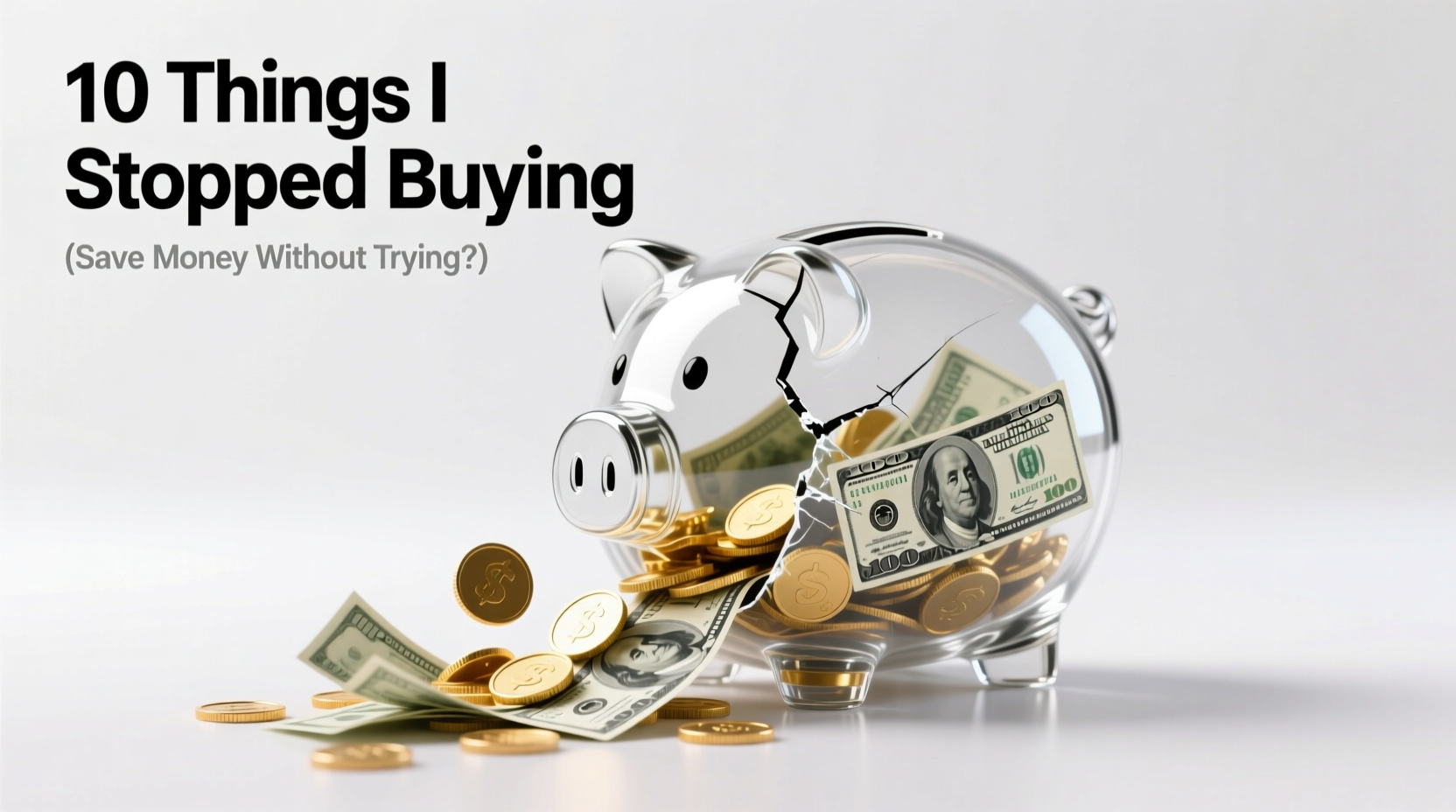
10 Things I No Longer Spend Money On: A Decade of Smarter Spending
I started meticulously tracking my expenses back in 2014. What began as a simple budgeting exercise evolved into a profound realization about my relationship with money and consumption. Over the last ten years, I’ve learned a powerful lesson: we don’t need to consume nearly as much as we think we do.
Often, our impulse to buy leads directly to a financial life that feels cluttered and out of control. I discovered that by consciously cutting out certain types of wasteful spending, I could save a surprising amount of money. This isn’t about deprivation; it’s about intentionality. The money saved isn’t just a number in a bank account—it’s freedom. It’s capital that can be invested for the future, used for meaningful experiences like a vacation, or simply act as a buffer against life’s uncertainties.
The smallest changes, when sustained, can accumulate into a significant sum. Today, I want to share the ten things I’ve consciously stopped buying, and the financial and mental clarity that followed.
1. The Allure of Airbnb Has Faded
There was a time when Airbnb felt like the ultimate travel hack. I remember a solo trip to Europe back in 2016-2017, where I spent three full weeks living exclusively in Airbnbs. They were the cool, affordable alternative to sterile hotel rooms, offering a glimpse into local life and unique accommodations you couldn’t find anywhere else.
But a shift happened, particularly after the pandemic. The cost structure changed dramatically. What initially seemed like a great nightly rate was often dwarfed by exorbitant cleaning fees and other host-determined charges. Suddenly, that charming apartment wasn’t so budget-friendly.
Beyond the price, the experience itself lost its luster. The initial charm of a “unique, original place” was often replaced by a feeling of commercial standardization. It became clear that many landlords were buying properties specifically to list them on Airbnb, creating spaces that felt more like impersonal rental units than someone’s home. They began to lack the very personality that made them special.
Finally, I considered the hidden costs of convenience. Airbnb locations can be isolated, often lacking the immediate amenities and food options that surround most hotels. And the checkout process—stripping beds, taking out the trash, following a specific list of chores—started to feel like work. I realized that for a similar price, a hotel offers a seamless experience: professional service, membership points, and the simple luxury of walking away at checkout without a list of chores. The value proposition had completely flipped for me.
2. The Physical Book Pile-Up
Now, this one might seem a bit contradictory, especially if you glance at the bookshelf behind me. But here’s the truth: I haven’t purchased a new physical book in a very long time.
Don’t get me wrong, I adore books. I love learning and diving into new concepts. There was a period where I was buying two or three books a week, driven by the promise of knowledge they held. The problem was, I’d often read only ten or twenty pages before the next shiny title caught my eye. I’d promise myself I’d come back to it later, but that day rarely came.
I realized that much of my purchasing was focused on non-fiction and self-improvement, which aren’t always designed for cover-to-cover reading. My habits for consuming information evolved. Now, I gravitate towards audiobooks during my commute or podcasts while doing chores. If a book truly captivates me, my first move is to ask a friend if they have a copy I can borrow.
The bookshelf you see represents my entire collection. If I buy another physical book, I have to ask: where will it go? This conscious decision has saved me money and, just as importantly, has prevented the mental clutter that comes from a pile of unread books gathering dust on a shelf.
3. The Loyalty Tax on Auto Insurance
This change was born from a simple life shift. A few years ago, I moved to San Francisco. My annual driving mileage plummeted from 12,000-15,000 miles to just 3,000-4,000 miles. I was barely using my car.
It occurred to me that my insurance premiums didn’t reflect this new reality. So, I picked up the phone and called my insurance company to ask if I could get a better rate. That single, hour-long call now saves me about forty dollars every month.
This isn’t just my unique situation. A 2019 study revealed that Americans overpay on insurance by nearly $37 billion each year. And that was six years ago; the figure is likely much higher now. That same study found the average American was overpaying by about $330 annually. This “loyalty tax” often has no rational basis. Many of us stick with an insurer out of inertia, or because it’s the company our parents used.
Spending just one hour a year to compare rates can easily save you hundreds of dollars. It’s one of the most straightforward financial optimizations you can make. The key is to ensure you aren’t paying for coverage you don’t need, especially when your circumstances—like your annual mileage—change significantly.
4. The “One-Event” Wardrobe
How many of us have fallen into this trap? You have a special event—a wedding, a party, a themed gathering—and you feel the pressure to look your best. So, you go out and buy a brand-new outfit specifically for that single occasion.
I’ll use myself as a guilty example. I was once invited to a rodeo and decided that buying a cowboy hat was an excellent idea. Since that rodeo in 2022, how many times have I worn that hat? Zero. I’m not even entirely sure where it is anymore.
This is a common phenomenon, and it’s a surefire way for money to literally hang in your closet, unworn. My new rule is simple: if I can’t envision myself wearing an item at least a few times a year, I will not buy it. The cost per wear for a single-use item is astronomically high. Now, I either borrow from friends, wear something I already own, or if I must buy, I choose something versatile that can be integrated into my regular wardrobe.
5. The Cable Television Trap
For a while, I subscribed to a live TV streaming service, initially lured in by a promotional price to watch live sports. It was convenient and, at first, felt reasonably priced.
But as time went on, the monthly fee crept up. It started around fifty dollars, but by the beginning of this year, I received an email notifying me that my subscription would be increasing to over eighty dollars per month. That was the final straw. I canceled it immediately.
I did the math: at over eighty dollars a month, I was looking at nearly a thousand dollars a year just to watch a handful of sports games. Since I don’t watch regular TV, this was an enormous expense for very little return. The value simply wasn’t there for me.
The calculus is different for everyone. If you watch fifty hours of television a month, your cost per hour of entertainment is low. But for me, at just a few hours, that cost was exorbitant. It was a clear reminder to periodically evaluate our recurring subscriptions and ask, “Is this still bringing me enough joy to justify its cost?”
6. Investing in What I Don’t Understand
This point is arguably one of the most important on this list. I’ve learned, through a bit of pain, to never put money into investments I don’t thoroughly understand.
It’s a common mistake. A friend mentions a “can’t-miss” stock or a hot new startup, and the fear of missing out takes over. You throw a little money in without doing any real due diligence, thinking it’s harmless.
For me, this wasn’t about stopping a “purchase” in the traditional sense, but about stopping the flow of capital into areas of ignorance. For instance, I don’t understand the world of angel investing. While I’ve been presented with opportunities to write a check for a few thousand dollars to a private company, I have no framework to judge whether a new startup is a good bet. The reality is, most angel investments fail.
My most regrettable investment was in a medical device company in 2022. A friend of a friend was starting it, and I trusted the connection. Did I look at their financials? Yes. But I had no fundamental understanding of the medical device sector. What should their gross margins be? What does a healthy growth trajectory look like? I was clueless. Within seven months, the company folded, and my five thousand dollars vanished.
Now, whether it’s a mutual fund, a bond, or a savings account, I make sure I know exactly what I’m investing in. You have to understand how your money is working for you. Blind investing is just glorified gambling.
7. The Bulk Food Illusion
The giant warehouse store is a temple of perceived savings. Buying in bulk should save you money, and in theory, it does. The unit price is almost always lower. But theory and practice often diverge in my kitchen.
I used to go to Costco and buy enormous quantities: a multi-gallon box of milk, a two-dozen pack of eggs, and giant packs of chicken breast or steak. The problem was, I live in a household of one. I simply couldn’t consume it all before it spoiled.
I lost count of the number of times I had to pour expired milk down the sink or throw out freezer-burned meat. The guilt was twofold: wasting food is terrible, and wasting money is frustrating. I was spending extra to throw things away.
The lesson here is balance. Bulk buying is fantastic, but only if you have the household size and consumption habits to match. Now, I’m much more strategic. I still buy non-perishables in bulk, but for fresh food, I’ve shifted to smaller, more frequent grocery trips. The goal is to have an empty refrigerator before I restock, not a full one with rotting food.
8. The Siren Song of “The Sale”
This might sound counterintuitive. Who doesn’t love a good deal? But I’ve learned to be deeply wary of spontaneous sale purchases.
Frequent promotions are often a marketing tactic designed to create a reason for you to buy, not to help you save. There’s a Gap store near my apartment in San Francisco that perpetually has a “40% Off Everything” sign in the window. I know people who will go in, spend three hundred dollars, and proudly proclaim they “saved” six hundred.
My perspective is different: they spent three hundred dollars they had no intention of spending in the first place. Just because you spent less than the sticker price doesn’t mean you saved money; it means you spent money.
My rule is now to only buy something I already needed or had been planning to purchase. If it happens to be on sale, that’s a wonderful bonus. The crucial habit is to not let the discount itself be the reason for the purchase.
The one exception I make is for planned, seasonal sales like Black Friday. If I know I need a new laptop and I’ve done my research, waiting for a known sale event is a smart financial move. But for the unplanned, impulse-driven sale? I’ve learned to walk on by.
9. The Redundant Software Subscription
During the pandemic, certain tools became essential. I paid for a Zoom premium subscription, around seventeen dollars a month, primarily to host calls longer than forty minutes.
As time passed, I took stock of the landscape. Video conferencing software became ubiquitous and fiercely competitive. Google Meet, Microsoft Teams, Discord, and even Slack now offer robust, free video calling features that easily handle my needs.
I scrutinized the benefits of my paid Zoom plan and realized I used none of them. I don’t host webinars or need to have one hundred participants in a meeting. The subscription had become a zombie charge on my credit card—a small monthly fee for a service I could get for free elsewhere. Canceling it was an easy decision and a reminder to audit my digital subscriptions quarterly.
10. The Overpriced Extended Warranty
Finally, we have the extended warranty. Whenever you buy an electronic device at a place like Best Buy or Costco, you’re almost always offered an extended warranty plan for an additional cost.
I have come to view these as generally poor value. They are often significantly overpriced relative to the actual risk of your product failing. Furthermore, they are filled with exclusions and fine print that can make it surprisingly difficult to get a claim approved when you need it most.
The worst feeling is having paid for a warranty, only to find out the specific problem you’re having isn’t covered. Manufacturers and retailers bank on you forgetting about the warranty or your product lasting beyond the covered period.
My personal strategy is to self-insure. I forgo the extended warranty and, if the product genuinely fails outside the standard manufacturer’s warranty, I will pay for the repair or replacement out of pocket. In the long run, I am confident this approach saves me money. The funds I don’t spend on warranties for all my gadgets easily cover the rare occasion when one actually breaks.
A Final Thought on Conscious Spending
Reviewing this list, the common thread isn’t just frugality; it’s mindfulness. It’s about questioning every expense, not out of stinginess, but out of a desire to align my spending with my actual values and lifestyle. The money saved from these ten categories has collectively had a massive impact on my financial well-being, providing me with more security and more freedom.
I’m curious to know if you’ve had similar experiences. Have you stopped buying any of these things? What’s on your personal list of abandoned expenses? Sharing these insights is how we all learn to make smarter financial decisions.