






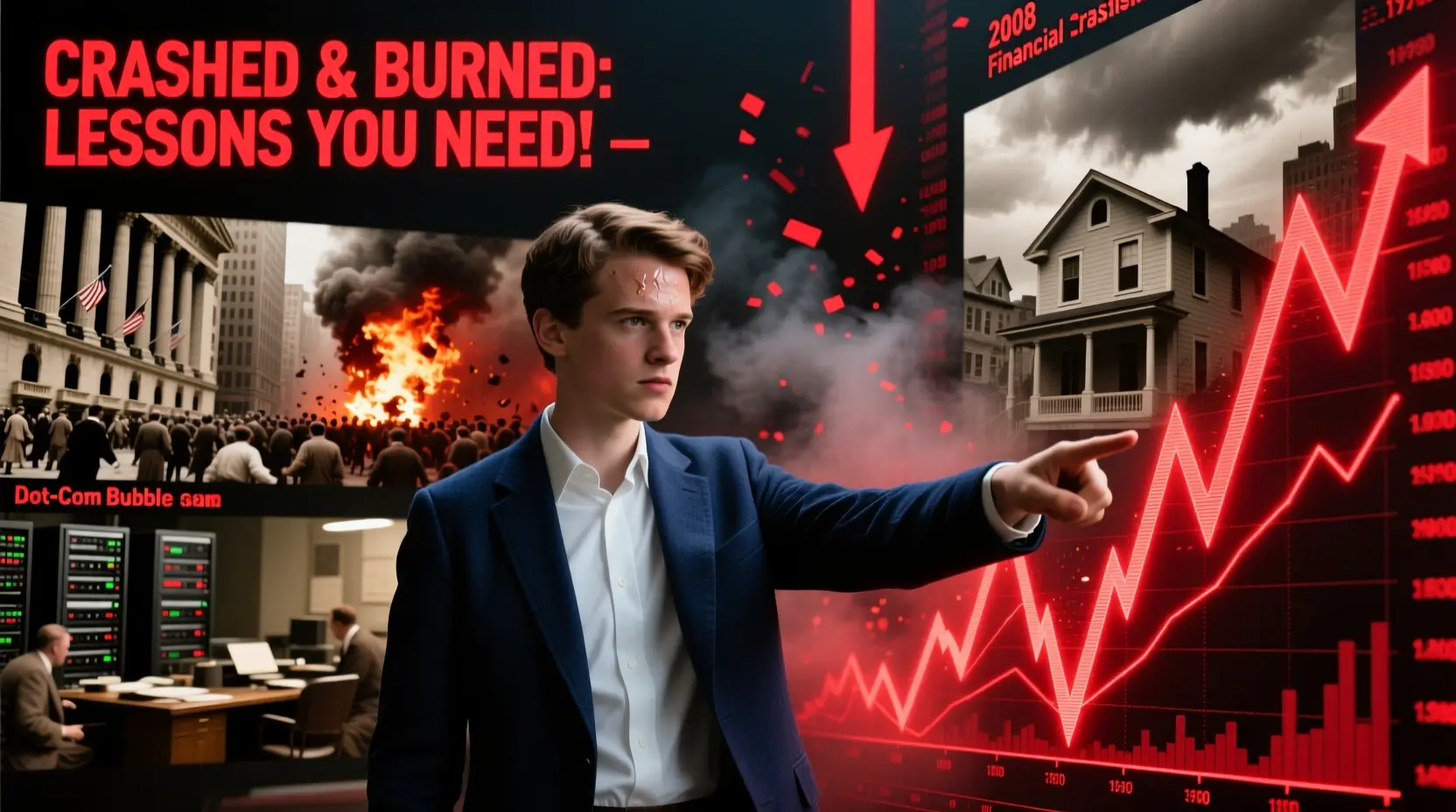
Echoes in the Canyon: The Unending Lessons of Market Crashes
The dawn of financial history is littered with chaos, panic, and catastrophic losses. It’s a landscape scarred by the deep canyons of economic collapse, each one telling a story not just of numbers and percentages, but of human dreams dismantled and fortunes evaporating into thin air. From the roaring, carefree highs of the 1920s to the tech-fueled, reality-detached frenzy of the early two-thousands, market crashes have left a trail of devastation—but more importantly, they’ve left us with lessons that can shape smarter investing. Understanding these lessons isn’t just academic—it’s survival. It’s the difference between being a leaf tossed in the storm and a tree with roots deep enough to withstand it. We are, in a very real sense, standing on the shoulders of all those who stumbled before us, and if we listen closely, we can hear their warnings on the wind.
The Great Illusion: The Wall Street Crash of 1929
The story of modern market catastrophes truly begins in the gilded age of the 1920s. The Great War was over, and a spirit of unprecedented optimism seized America. Jazz music filled the air, new technologies like the radio and the automobile were transforming daily life, and on Wall Street, a new religion was born: the perpetual ascent of stock prices. It was a time when it seemed the sky was the only limit. But this euphoria was built on a fragile, and ultimately dangerous, foundation.
The Roaring Twenties taught the world a brutal truth: unchecked optimism can be deadly. It wasn’t just that people were hopeful; they were delusional, convinced that the old rules of economics had been suspended. This collective mania was supercharged by the widespread adoption of margin trading. In the years leading up to the crash, buying stocks with borrowed money—sometimes putting down only 10% of the stock’s value—became commonplace. It was a seductive trap. An investor with $1,000 could control $10,000 worth of stock. If that stock rose to $11,000, they had effectively doubled their money. This practice exploded, inflating prices far beyond any semblance of corporate reality.
The landscape was one of pure speculation. People weren’t investing in companies; they were betting on ticker symbols. Stories abounded of chauffeurs and shop clerks giving stock tips, all convinced they had found a shortcut to immense wealth. The market became a national pastime, a giant casino where everyone seemed to be winning. But this created a house of cards, where the value of the entire structure was dependent on a constant influx of new buyers and new debt.
When reality finally hit in October of 1929, it didn’t just knock on the door; it kicked it down. The trigger was a loss of confidence. As some savvy investors began to cash out, prices started to wobble. This gentle wobble was all it took to unleash the deadly mechanism of the margin call. As stock prices fell, brokers demanded that investors put up more cash to secure their loans. These investors, who had never actually owned the full value of their stocks, had no cash left. They were overextended. So, to meet the calls, they had no choice but to sell their holdings.
This forced selling drove prices down further, which triggered more margin calls, which forced more selling. It was a vicious, self-feeding cyclone of panic. The mass sell-offs of Black Thursday and the catastrophic Black Tuesday weren’t just acts of fear; they were acts of financial necessity for millions. Life savings were wiped out overnight. The paper fortunes that had seemed so real simply vanished. The lesson here is as stark today as it was then: leverage magnifies both gains and losses. Using borrowed money can create spectacular, intoxicating growth, but in a downturn, it acts like a noose, tightening with every decline in price. It can wipe out everything overnight, leaving nothing but the debt behind.
The New Era Mirage: The Dot-Com Bubble
If the Crash of 1929 was a lesson in the dangers of debt, the next great crash was a lesson in the dangers of delusion. Fast forward to the late nineteen-nineties. A new, seemingly magical frontier had opened up: the internet. It promised to reshape commerce, communication, and society itself. And with this promise came a gold rush that made the 1920s look tame. This was the Dot-Com Bubble, a period where rationality took a backseat to sheer, unadulterated hype.
Suddenly, any company with a “.com” in its name was presumed to be worth billions. The old metrics of business—things like revenue, profit, and sustainable growth—were dismissed as relics of a bygone “brick-and-mortar” age. The new mantra was “get big fast.” Market share was all that mattered. Profitability? That was a problem for the future. Investors, from massive mutual funds to everyday individuals, ignored fundamentals, chasing the siren song of technological revolution over substance.
The stories from this era are now legends of folly. Companies with no revenue, no profits, and often no clear business model reached astronomical valuations based on little more than a slick website and a buzzword-filled business plan. Pets.com, a company that lost money on every bag of dog food it sold, saw its stock soar after a Super Bowl ad. Webvan spent over a billion dollars building automated warehouses before it had a single customer to serve them. The stock market became a stage for a grand performance, where the appearance of innovation was more valuable than innovation itself.
The atmosphere was one of collective insanity. Day trading became a national hobby, with people quitting their jobs to stare at computer screens full-time, convinced they had cracked the code. CNBC was on in every bar and office, the constant chatter of analysts fueling the fire. The NASDAQ index, home to most tech stocks, quintupled in just a few years. It felt like a new, permanent plateau of prosperity had been reached.
And then it popped. It didn’t happen in a single day, but the unraveling in 2000 was swift and merciless. The reality that a business, even an internet business, must eventually generate cash to survive finally dawned. As companies burned through their venture capital and failed to find a path to profitability, they began to shutter their virtual doors. One by one, the dreams collapsed. The NASDAQ fell nearly 80% from its peak, wiping out trillions of dollars in wealth. The lesson here is timeless and non-negotiable: fundamentals matter. No matter how exciting a trend seems, no matter how revolutionary the technology, a business must generate real, tangible value to survive. The markets, eventually and without fail, punish the irrational. The excitement of the new can blind us, but gravity always reasserts itself.
The House of Cards: The 2008 Financial Crisis
Just as the world was recovering from the hangover of the tech bust, an even more profound and systemic crisis was brewing, this time not in the flashy world of Silicon Valley, but in the very bedrock of the American economy: the housing market. The 2008 Financial Crisis was different. It wasn’t about naive optimism in new technology; it was about a sophisticated, willful blindness and a corruption of the financial system itself.
This crisis was born from the collapse of subprime mortgages—loans made to borrowers with poor credit history. Driven by a policy of increased homeownership and the insatiable appetite of Wall Street for high-yielding investments, lenders began writing mortgages with little to no documentation, known as “liar loans.” The assumption was that housing prices would only ever go up, so if a borrower defaulted, the bank could just repossess a more valuable asset. This was the first crack in the foundation.
But the real catastrophe was engineered in the skyscrapers of Lower Manhattan. These risky mortgages were bundled together into complex instruments called Collateralized Debt Obligations (CDOs). By slicing and dicing thousands of these mortgages into tranches, financial alchemists magically transformed risky subprime loans into “AAA-rated” investment-grade securities. It was a shell game of epic proportions. To make matters even more opaque, a massive market for credit default swaps—essentially insurance policies on these CDOs—sprang up, creating a tangled, multi-trillion-dollar web of interlocking risk where no one truly knew who was on the hook for what.
The entire global financial system became a game of Jenga, with each block representing a layer of debt and derivatives. When homeowners began defaulting on their mortgages in waves, the first blocks were pulled out. The CDOs, packed with these toxic assets, began to plummet in value. The institutions that held them—banks, pension funds, insurance companies—faced catastrophic losses. The web of credit default swaps meant that the failure of one institution, like the investment bank Bear Stearns, threatened to pull down all the others.
Trust, liquidity, and transparency—the three pillars of finance—shattered simultaneously. Banks that appeared invincible, like Lehman Brothers, suddenly crumbled into bankruptcy. Others, like AIG, were only saved by massive government bailouts. Banks became so terrified of each other’s hidden losses that they stopped lending to one another. Credit, the lifeblood of the modern economy, froze solid, dragging the global economy into the worst recession since the 1930s. The lesson from this disaster is stark and critical: understand the instruments you invest in. Complexity can mask risk, and opaque financial products can conceal catastrophic exposure. When something seems too good to be true, and you can’t explain how it works in simple terms, it’s not a sign of your ignorance, but of the investment’s inherent danger.
The Ghost in the Machine: The Psychology of Panic
As we trace the arc of these disasters—from 1929, to the Dot-Com Bubble, to 2008—a recurring, haunting pattern emerges that transcends charts and economic data. It’s the pattern of human behavior itself. The fundamental forces driving these cycles are not found in spreadsheets, but in the deep, often irrational, recesses of the human mind.
Greed inflates bubbles. It’s that intoxicating feeling of watching your neighbor get rich and feeling the irresistible urge to join in. It’s the fear of missing out (FOMO) that drives sensible people to pour money into an overheated market, rationalizing that “this time it’s different.” This herd mentality creates the fuel for the fire, pushing prices to unsustainable heights. During the dot-com boom, it was the greed for 1,000% returns. In 2008, it was the greed of bankers for massive bonuses and the greed of homeowners for easy credit.
Then, when the bubble pops, fear accelerates the crash. It’s not just prudent caution; it’s a blind, primal panic. The same herd that rushed in now stampedes for the exits. Rational calculation goes out the window, replaced by a single, overwhelming imperative: Sell now, ask questions later. This panic selling creates the very devastation everyone fears, driving prices far below their intrinsic value. It’s a self-fulfilling prophecy of doom.
Linking these two emotions is overconfidence. It’s the cognitive bias that makes us believe we are smarter than the average investor, that we can time the market perfectly, that we can get out before the top and get in at the bottom. History laughs at this notion. Overconfidence blinds investors to warning signs and convinces them that the old rules don’t apply to them.
Lesson four, therefore, is the most personal and perhaps the most difficult to master: emotion is your enemy. History repeatedly shows that market timing driven by panic or euphoria leads to ruin. The investor who sells in a panic locks in their losses. The one who buys in a euphoric frenzy is buying at the peak. Staying disciplined, diversified, and level-headed is often the most powerful, albeit unglamorous, strategy of all. It’s about having a plan and sticking to it, even when every instinct is screaming at you to do the opposite.
The Phoenix Principle: Resilience and Recovery
To focus only on the carnage of a crash, however, is to miss half the story. For all the destruction they cause, market crashes are not permanent endings. They are, in the grand sweep of economic history, brutal but temporary resets. They are the forest fire that clears out the undergrowth, allowing for new, stronger growth to emerge. This leads us to the final, and most hopeful, lesson.
Markets always recover. It is their inherent nature. The American market not only recovered from the Great Depression but went on to reach new, unimaginable heights. The companies that survived the Dot-Com bust—Amazon, Google, Apple—became some of the most valuable entities in human history. The global economy, though scarred, weathered the 2008 crisis and embarked on the longest bull market in history.
This is not to downplay the pain, which is very real for those who lose jobs and homes. But from an investment perspective, this historical truth is our anchor. Post-crash periods are not just times of destruction—they are opportunities. They are the moments when great fortunes are built, when stocks of phenomenal companies are on sale at bargain-bin prices. The legendary investor Warren Buffett famously advised to “be fearful when others are greedy and greedy when others are fearful.” A market crash is the ultimate moment of widespread fear.
Therefore, lesson five is the virtue of the long game: patience pays. Those who hold through the storm, who adapt their strategies without abandoning them, and who continue to invest wisely during the downturn often find themselves richly rewarded when markets inevitably rebound. Compounding wealth takes time, and it is most powerful when given a long runway. Crises, as devastating as they are, can lay the foundation for future gains for those with the fortitude to see them through. It’s about understanding that the market is a mechanism for transferring wealth from the impatient to the patient.
Carrying the Lessons Forward
By studying past crashes, we don’t just relive tragedy—we arm ourselves with knowledge for the inevitable storms of the future. The next crash will come. We don’t know when or what will trigger it, but the cycles of human psychology and economic activity guarantee it. Our task is not to predict the unpredictable, but to prepare for it.
The lessons are our guideposts. Leverage cautiously, understanding that debt is a double-edged sword. Insist on fundamentals, remembering that no hype can forever disguise a lack of value. Understand what you own, avoiding complex products that obscure true risk. Control your emotions, recognizing that fear and greed are the siren songs that lead to the rocks. And finally, remain patient, trusting in the historical resilience of markets and the power of long-term compounding.
Crashes are inevitable, but financial devastation doesn’t have to be. The markets will always rise and fall, driven by the timeless rhythms of greed and fear. But the investor who learns from history, who carries these hard-won lessons in their mind and their strategy, can do more than just survive—they can position themselves to thrive through every storm, emerging on the other side stronger and wiser. The echoes in the canyon are not just warnings; for the prepared, they are a map.