





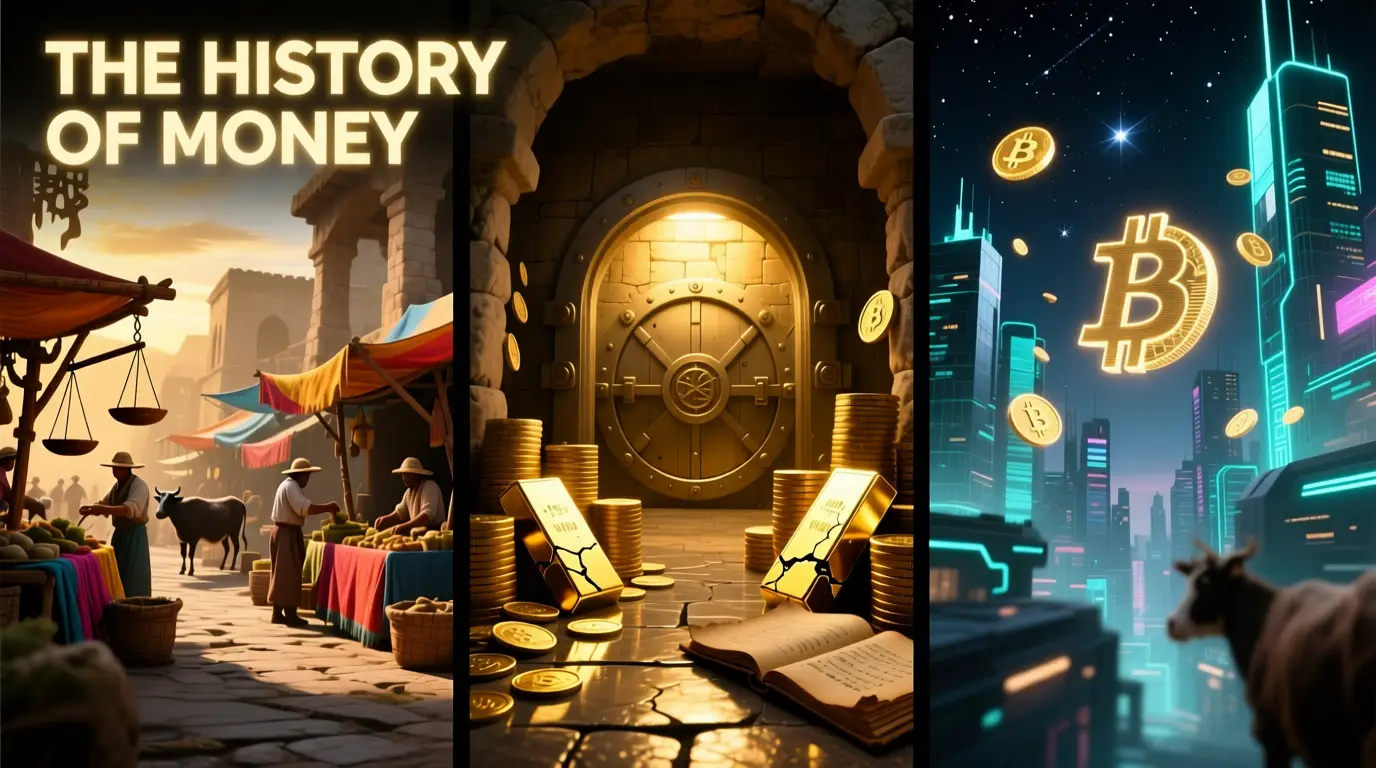
The Story of Money is the Story of Us
The story of money is, in many ways, the story of human civilization itself. It’s a tale woven into the very fabric of our societies, a silent partner in every triumph, every trade, and every step forward we’ve taken as a species. To trace its evolution is to trace our own—our ingenuity, our conflicts, and our relentless desire to connect and build. It all started not with a bang, but with a simple, quiet agreement between neighbors.
Long before coins clinked in pockets or digital wallets beeped with transactions, people relied on barter—the direct, often messy, exchange of goods and services. Imagine a world without a common measure of value. A farmer, his hands calloused from the harvest, stands in a dusty market, eyeing a beautifully crafted clay pot. The potter, in turn, needs food for his family. A deal is struck: a hefty sack of grain for the sturdy pot. This was the beginning. Simple, yet profoundly inefficient. What if the potter didn’t need grain that week? What if the farmer only needed half a pot’s worth of goods? How do you divide a cow to pay for a new pair of sandals? The system was shackled by what economists call the “double coincidence of wants.” Both parties had to want what the other offered, at the exact same time, and in the exact same quantity. As villages grew into towns and towns into cities, as trade routes stretched beyond the horizon, the limitations of barter became a cage. There was a growing, palpable need for something else—something universally accepted, something portable, something durable. A medium that could represent value, a token of trust that could bridge the gap between a farmer’s harvest and a potter’s craft.
The Metallic Revolution: When the World Began to Clink
And so, we arrive at a moment of revolution, not on a battlefield, but in a marketplace in ancient Lydia, around six hundred years before the common era. Here, along the fertile coast of what is now Turkey, a brilliant innovation was minted: the first coin. These weren’t the perfectly round, milled coins we know today. They were small, lumpy discs, often made of electrum, a mysterious and beautiful naturally occurring alloy of gold and silver, found in the local riverbeds. They were stamped with simple marks, a lion’s head, a seal of authority from the king. This was genius. Suddenly, value was standardized. A coin’s worth was not in the lump itself, but in the mark it bore, a promise from the ruling power that this piece of metal held a guaranteed, recognizable value.
The impact was immediate and electrifying. Trade was no longer a local affair. A merchant from Lydia could now travel to a distant Greek city-state and have his payment understood. The coin was a universal language, spoken in the common tongue of commerce. The idea spread like wildfire through the ancient world. The Greeks refined the concept, creating stunning silver coins adorned with their gods and goddesses—the owl of Athena became a symbol recognized from Egypt to the Black Sea. The Romans, masters of administration and empire, built their vast infrastructure on a standardized currency, the denarius, financing legions and building aqueducts with the clink of metal. In Persia, the daric carried the image of a running king, a symbol of imperial power. Money was no longer just a tool for trade; it had become a reflection of civilization itself—its art, its authority, its reach, and its culture. It was a portable piece of home, and a key that unlocked the world.
The Weight of Wealth and the Birth of Paper Promises
But for all their glory, coins had their limitations. Imagine a merchant seeking to purchase a shipload of silk or a vast estate. Carrying the required sum in silver or gold would be a monumental task—a chest of heavy, clattering metal, an open invitation to thieves and bandits on every lonely road. The very substance that gave coins their value also made them vulnerable. Metal was heavy, it could be shaved or clipped by unscrupulous hands, and its supply was at the mercy of mine discoveries and conquest.
A new solution was brewing, this time in the East. By the seventh century CE, during the Tang Dynasty in China, a novel idea began to circulate among merchants. Instead of carrying heavy strings of bronze coins, they would deposit their metal with a trusted agent—a merchant guild or even a monastery—and receive a paper receipt in return. This receipt, known as a “jiaozi,” was a promissory note. It was a piece of paper that represented the stored coinage, a promise to pay the bearer the stated amount on demand. It was lightweight, concealable, and, most importantly, it was trusted.
This concept of paper representing value was a seismic shift in human thought. It slowly traveled the Silk Road westward, taking root in the Italian city-states like Florence and Venice during the Renaissance. Here, the great banking families sat at their benches—the ‘bancos’ from which we get the word ‘bank’—and began to issue their own notes. With paper money came the sophisticated architecture of modern finance: the concept of credit, of storing value not in a chest but in a ledger, of issuing loans to fuel ventures and ambitions. A bank could now lend out more than it physically held, creating capital out of confidence. This system could fuel commerce, exploration, and industry on a scale the ancient world could never have imagined. The Age of Exploration, the Industrial Revolution—they were all financed on this very principle: that a promise on paper could hold more power than a mountain of gold.
The Invisible Ledger: From Plastic to Pixels
Fast-forward to the modern era, and the dematerialization of money accelerated at a breathtaking pace. The 20th century introduced us to money that wasn’t just paper, but plastic. Credit and debit cards, first as simple charge plates and then with magnetic stripes and microchips, began to turn currency into data. The physical act of handing over cash was replaced by the swipe of a card, the imprint of a machine. Money was becoming an idea, a number in a system.
Then came the internet. Online banking, digital transactions, and e-commerce completed this transformation. Today, for many of us, money is entirely invisible. We pay bills with a click, transfer funds with a tap on a smartphone, and receive salaries as a direct deposit into an account we never see in physical form. We trade stocks, buy groceries, and split a dinner bill with friends, all without a single coin or note changing hands. The trust that was once placed in a stamped piece of metal, then in a printed banknote, is now placed in complex digital systems, encrypted data, and financial institutions that operate in the cloud.
A Decentralized Future: The Cryptocurrency Gambit
And in the twenty-first century, the next great chapter is being written, one that challenges the very foundations of the financial systems built over the last millennium. The rise of cryptocurrencies like Bitcoin has introduced a radical new form of money—decentralized, purely digital, and not controlled by any government, bank, or central authority. Born from the digital ashes of the 2008 financial crisis, cryptocurrency is a product of our time: global, networked, and skeptical of traditional power structures.
It operates on a technology called blockchain, a public, distributed ledger that records every transaction across a network of thousands of computers. It is secured by cryptography, making it incredibly resistant to fraud or tampering. Cryptocurrency embodies both the dazzling promise and the profound uncertainty of money’s future. It promises a financial system that is secure, transparent, fast, and borderless, allowing for the instantaneous transfer of value anywhere in the world, at any time, without intermediaries. Yet, it is also wildly volatile, a playground for speculators, and still poorly understood by the masses. It raises fundamental questions: What is value without a physical object or a central guarantor? Can we trust a code more than we trust a central bank?
The Unbroken Thread: A Mirror of Our Ambition
Throughout this incredible history, from grain and livestock to coins, banknotes, and cryptocurrencies, one unbroken thread remains: money has evolved in lockstep with human ingenuity and societal complexity. Each transformation—from barter to coin, from coin to paper, from paper to digital bits—reflects humanity’s ongoing, relentless quest to simplify trade, to store wealth efficiently, and to assign value in a way that facilitates progress. Money is far more than a mere economic tool; it is a mirror. It reflects our culture, showcasing our art and symbols. It reflects our technology, from the minting press to the blockchain. And most of all, it reflects human ambition—our drive to explore, to build, to create, and to connect across ever-widening circles.
In the end, whether it jingles as a worn silver coin in your pocket, rustles as a crisp banknote in your wallet, or exists as a silent, immutable string of code on a decentralized blockchain, money tells the story of human progress. It is the lifeblood of civilization, the measure of our labors, and the token of our trust in one another and in the future. And as we stand on the brink of a new era, a future of central bank digital currencies and perhaps forms of money we cannot yet conceive, the long history of money offers a comforting, profound reminder. It reminds us that every revolution, every single innovation, begins with that same, simple, ancient human desire: the desire to exchange, to connect, and to thrive, together.