







The Great Disconnect: Why the Economy is Crumbling While Markets Hit Record Highs
You feel it in the air. You see it in the headlines. You hear it in conversations with friends.
Layoffs are stacking up. The cost of groceries seems to rise every time you walk into the store. Credit card balances are maxed out, and people are quietly drowning in debt. Respected economists are appearing on financial networks, their voices tense as they warn that what’s coming could be worse than 2008.
And honestly, looking at the state of the real economy, it makes sense. When things look this bad, markets should crash. History tells us they always do.
But what if they don’t?
What if something so fundamental has shifted in the financial landscape that the old rules no longer apply? What if the markets can remain buoyant even as the economy beneath them collapses?
Having built and sold tech companies through multiple boom and bust cycles, and now, as a partner at a leading Bitcoin venture fund, I’ve learned to look past the headlines for the structural shifts that truly matter. What I see today is a system that has fundamentally broken in two. The link between Main Street and Wall Street has been severed.
This isn’t a temporary glitch. It is the final phase of an old model.
And it all centers on one powerful, terrifying, and opportunistic concept: belief.
The World You Actually Live In: A Physical Economy Under Siege
Let’s start with the world you and I actually live in, not the one portrayed on financial news networks.
In your world, things feel tight. Essentials cost more. The credit card statement each month brings a wave of anxiety. It seems like every week brings news of another round of layoffs at companies we once thought were untouchable. The idea of a robust “recovery” feels like a distant, theoretical concept.
And yet, against this backdrop of palpable strain, the stock market is celebrating new all-time highs and record profits. The dissonance is jarring. It doesn’t add up.
Every logical bone in your body tells you this can’t last. And you’re right. The real economy, the one built on paychecks, grocery bills, and car payments, is quietly falling apart. You can see it in the companies that are supposed to be bulletproof—the ones that make the stuff you buy every single week.
We call them consumer staples for a reason. They are the staples of daily life. They are non-negotiable.
But look at their performance:
- Clorox is down nearly 40% from its 2022 peak.
- Kraft Heinz is down 30% just this year.
- Procter & Gamble, the very definition of a boring, reliable blue-chip, is down 20%.
- General Mills has lost more than one-third of its value in this year alone.
These aren’t speculative tech startups or luxury brands. They sell soap, cereal, and cleaning supplies—the most essential items in your pantry. When the bedrock of consumer necessity begins to crack, it tells you something is breaking at the very foundation of the economy.
The Tapped-Out Consumer: An Engine Running on Fumes
The American consumer has been the engine of the global economy for over 80 years. That engine is now sputtering.
Credit card balances have hit a record-shattering $1.3 trillion. Let’s be clear: this isn’t debt being racked up for vacations or new gadgets. This is people using plastic as a lifeline just to get to the end of the month. The average interest rate on these balances has soared to over 24%—the highest in history. Unsurprisingly, delinquency rates are now the worst we’ve seen since 2012.
The median checking account balance is down approximately 40% since 2021. The message is stark: savings are gone. People are now floating their lives on a sea of revolving, high-interest debt.
The same story is playing out in the auto industry. Auto loan delinquencies have just hit their highest level since the 2008-2009 financial crisis. Repossessions are up 20% year-over-year. The average new car payment has eclipsed $740 a month—an insane figure for a depreciating asset.
When the consumer can no longer borrow, the music stops. Demand collapses. And that is precisely why we are seeing layoffs spread like wildfire across every sector, not just tech.
- UPS cut nearly 50,000 jobs.
- Ford and GM have let go of thousands of workers.
- Starbucks axed 5,000 corporate roles.
- Target is shutting down stores and cutting management.
- Even giants like Amazon and Nike are conducting “efficiency” rounds.
When companies that depend on everyday spending start cutting workers en masse, it’s because people have fundamentally stopped buying. Real wages are flat. The personal savings rate is near record lows. Mortgage delinquencies are up 20% year-over-year. Nearly half of all renters are now spending over 30% of their income just to keep a roof over their heads.
This is the part of the story that Wall Street doesn’t want to talk about. The middle class, the group that fueled decades of growth through consumption and credit, is running on fumes. The economic model that worked from 1950 to 2020 is breaking down. The system can no longer expand because the people holding it up are simply broke.
And yet, the market doesn’t seem to notice. The indices keep climbing.
How is this possible?
The Two Economies: When the Story Diverges from Reality
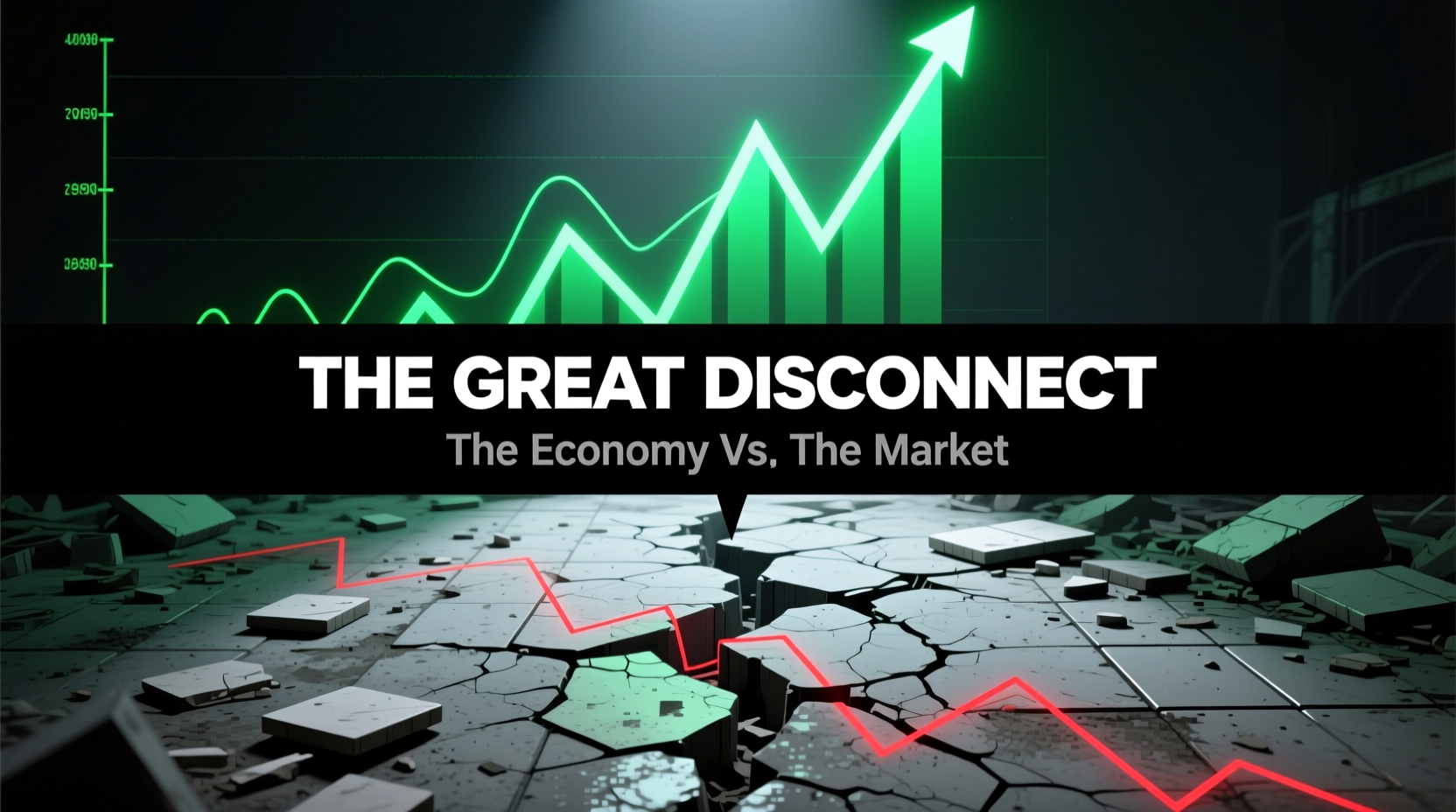
The answer is that we are now living in two separate economies.
There is the physical economy you live in, which is clearly breaking down. And then there is the financial economy, which looks utterly unstoppable.
The old rule was “Don’t fight the Fed.” The new rule is “Don’t fight the narrative.” Because that is exactly what is running the markets right now. It’s all running on belief.
If you only watch the headlines, the S&P 500 looks like it’s in a roaring bull market. But if you pull up the equal-weighted S&P 500—where each of the 500 companies counts the same—you’ll see a different story. It has barely moved.
It’s not 500 companies rallying. It’s a handful.
As Reuters put it bluntly, “A relatively small number of large stocks are propelling the market.” Those are the AI giants: Nvidia, Apple, Microsoft, Amazon, Google, Meta, and Tesla. By late 2023, just seven companies made up about one-third of the entire S&P 500’s valuation.
Nvidia alone was close to 8% of the whole index—the largest concentration we have ever seen in a single company. This means that when Nvidia moves just 1%, it can move your entire retirement account. That’s how narrow and fragile this rally truly is.
The AI Lifeline: Belief as the New Stimulus
This entire edifice is built around a single, powerful idea: Artificial Intelligence.
AI has become the lifeline for the entire market. Every earnings call, every analyst report, every valuation model ties back to AI. At one point this year, roughly half of all S&P 500 gains came from this small handful of AI-linked names. Half. For an index of that size, that concentration is staggering.
And here is the wild part: AI isn’t just a story anymore; it is becoming the new form of economic stimulus.
Total capital spending for S&P 500 companies hit a staggering $1.2 trillion this year, the highest since records began in the 1990s. Almost a third of that is coming from the same nine companies building out AI infrastructure.
So, even as consumer demand flatlines, massive corporate investment in AI is keeping GDP expectations alive. Valuations remain elevated not because of today’s profits, but because of tomorrow’s hope.
You see, Wall Street isn’t trading reality anymore. It is trading belief. The index isn’t pricing in current demand; it is pricing in a story about future productivity. Capital doesn’t need consumers right now. It needs conviction.
As long as investors believe that AI is the future, money will keep flowing in, even while the real economy struggles to breathe.
This is the synthetic economy. It’s not driven by spending or production. It’s driven by a narrative. And for now, that narrative is powerful enough to keep the entire illusion alive.
The Fiat Market: When Belief Becomes Policy
But what happens when belief turns into policy? What happens when markets stop being free and become fully “fiat”?
For 80 years, the formula was simple: you go to work, you earn money, you spend it. That spending drives production, which creates profits and lifts the markets. It was consumption-powered growth.
Now, the entire sequence has been inverted.
Just this past fall, the Federal Reserve didn’t just signal future rate cuts; they also hit pause on Quantitative Tightening (QT). This is central bank code for: “We are no longer going to drain liquidity from the system.” And liquidity is the rocket fuel for asset prices.
The Bank for International Settlements (BIS) even noted that global financial conditions eased this summer precisely because equities went up and credit spreads tightened. In other words, the markets themselves have become the stimulus.
We are now trapped in a feedback loop where bad economic news is interpreted as good news for markets. Weak jobs data? The market rallies on the expectation of more rate cuts. A slowing economy? More easing is on the way. Every data miss simply feeds the next leg higher.
This is the great inversion. The economy used to drive the markets. Now, the markets drive the economy.
Consider this: corporations have become the single biggest buyers of their own stock, with about a trillion dollars in buybacks authorized this year alone. Not consumers, not foreign investors. Companies are using access to cheap capital to push their own stock prices higher.
The Fed provides the liquidity. Wall Street channels it through corporate balance sheets. And stock prices keep rising. It’s a closed loop.
Even the Fed’s own researchers admitted that emergency programs were primarily about lowering “perceived” bank risk. It was never about fixing the fundamental system. It was about protecting confidence in the story. Belief itself has become the primary policy tool.
This is why I call it a “fiat market.” Just like our fiat currency, it is backed by confidence, not by tangible collateral. As long as the story holds, the system stays alive.
The Crash Up: The Grand Finale of the Belief Era
This brings us to the most critical point. The danger now is not the crash that everyone is waiting for.
For years, I have been warning that the greatest threat is not a deflationary crash down, but a catastrophic crash up.
We have a scenario where too much liquidity is chasing too little substance. Capital is flooding into the last narrative standing—AI. And while everyone is braced for a collapse, we are getting the opposite: a melt-up.
This is the grand finale of the belief era.
The Fed is poised to cut rates and halt the draining of liquidity. Trillions of dollars are waiting on the sidelines in money market funds, ready to rush back into the system. Corporate buybacks are running at a staggering pace.
It is hard not to see where this goes next. The same forces that inflated the bubble are now actively working to keep it inflated. And when a system runs purely on belief and liquidity, the end never comes as a slow decline. It comes as a parabolic, unsustainable explosion upwards.
The Two Failure Points: Where the Illusion Shatters
This isn’t a magical fairy tale with a happy ending. Let’s be clear. This system has two critical failure points.
- The Liquidity Crisis: This occurs if the Fed is forced to pull away the punch bowl. If inflation proves stubborn and the Fed cannot cut rates as expected, or is forced to tighten again, the engine of this market will instantly sputter. We’ve already seen glimpses of this fragility. The Fed had to pause its balance sheet runoff precisely to stop liquidity from evaporating during previous episodes of stress. The market itself has become the transmission mechanism for stimulus, and if that transmission is cut, the system seizes.
- The Belief Crisis: This is the more dangerous risk. If the AI narrative cracks, capital will fall back to earth at terminal velocity. The “Magnificent Seven” now control 30% of the S&P 500—a concentration we haven’t seen since the peak of the dot-com bubble. Analysts are already raising their 2025 S&P targets to 6400 or 6500 based almost entirely on AI optimism. But if this story breaks—if AI earnings disappoint, or if the promised productivity boom fails to materialize—the entire layer of belief propping up the market will collapse.
But before either of those failures hits, we are likely to see one last, spectacular surge. Some may call it a melt-up. I call it a crash up.
We can see the early stages now. Liquidity is rushing back in. Buybacks are authorized at over a trillion dollars. The risk appetite is exploding, with nearly $6 billion pouring into crypto ETFs in a single week recently. This is textbook late-cycle behavior. Policy loosens, flows accelerate, the leading stocks drag the index higher, and everyone pretends it’s a new boom.
This creates a final window of opportunity.
Positioning for the Reset: Proof Over Promises
The winners in the next phase won’t be the ones fighting the system. They will be the ones who understand it is a fiat construct and position themselves outside of its direct influence.
The fiat market runs on faith. Bitcoin runs on proof.
The Bitcoin supply doesn’t change because of a meeting in Washington D.C. It is fixed, immutable, and transparent: 21 million coins, locked in by unbreakable code. The hash rate—the real-world computational power and energy securing the network—is at an all-time record high. This is not a narrative. It is a verifiable fact, backed by mathematics and physics.
While the belief economy melts up, my focus is on the next system—the one built on proof, not promises. Because every time a fiat system reaches its endgame, a new, more resilient base layer rises from the ashes. This time, that base layer is Bitcoin.
The Path Forward: Building a Crash-Proof Foundation
So, here is where we stand. The economy is weak. The market is completely detached. The system is running on the fumes of belief and liquidity. That is the bad news.
The good news is that you are now aware of it. This knowledge gives you a monumental edge. You don’t need to predict the exact moment it ends. You simply need to understand how it works and position yourself outside of the fiat loop before it finally breaks.
What comes next isn’t just another business cycle. It is a reset. The people who prepare now will be the ones who help build and own the next system.
Since no one knows exactly when this crash up will end or how the reset will unfold, it is absolutely critical to have a financial system that works in both directions—crash up or crash down. You need a strategy that allows you to thrive regardless of the market’s manic moves.
The goal is to get off the roller coaster and build a wealth engine that runs on proof, not belief. This means automating your money flows, protecting your income, and consistently stacking real, verifiable assets even when the markets are at their most chaotic.
The next era will not reward those who simply predict the markets. It will reward those who are prepared for anything. The time to build that resilience is now, while the window of opportunity remains open.