






Of all the questions I encounter in the world of digital assets, one persists with unwavering frequency. It’s born from a place of understandable frustration and a tinge of regret. Over the past five years, Bitcoin has increased in price by a staggering 570%. For many looking in from the outside, this astronomical rise creates a daunting barrier. They see the price of a single coin—now hovering well into six figures—and feel they have missed the boat entirely.
This feeling of having arrived late to the party naturally leads investors, both new and experienced, to search for a backdoor entrance. They begin scanning the landscape for cheaper alternatives, asking, “What about Ethereum?” or, more commonly, “Is XRP the next big thing?” It’s this latter coin, XRP, that seems to inspire a particularly fervent brand of advocacy. I occasionally find a comment from an impassioned supporter, fervently making the case for XRP’s superiority over Bitcoin.
But this line of thinking, while common, rests on a fundamental misunderstanding. It conflates price with value and mistakes similarity in name for similarity in purpose. Today, we’re going to tackle that very question head-on: What is the best alternative to Bitcoin? My answer, whether you’re a regular reader or just stumbling upon this analysis, might surprise you.
We will place Bitcoin side-by-side with the two largest cryptocurrencies by market cap that often appear as its logical successors: Ethereum and XRP. Can these far cheaper options truly serve as viable substitutes for the original digital asset? Let’s find out.
The Allure of the “Cheaper” Coin
To understand the appeal, we must first look at the recent performance of these assets. Ethereum, often abbreviated as ETH, had its monumental breakout moment in the 2021 bull market. Its value skyrocketed more than tenfold in a single year, cementing its place as the undeniable number two. More recently, XRP had its own dramatic surge, climbing approximately 500% between November 2024 and January 2025, capturing headlines and investor imaginations.
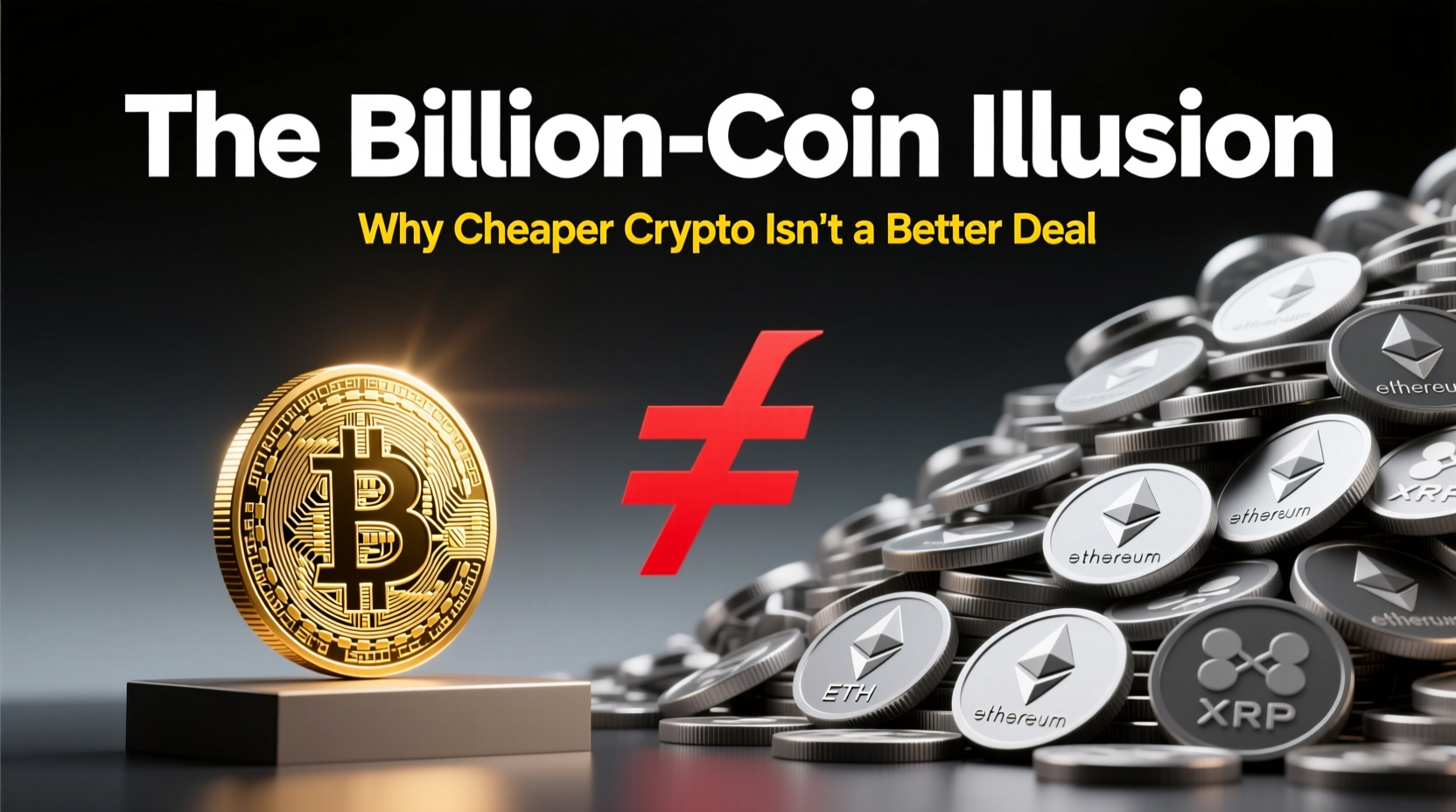
As of this writing, the price disparity is vast. Bitcoin trades around $110,000. Ethereum sits near $3,900, and XRP is roughly $2.50. This math is seductive. One Ethereum costs a mere 5% of a single Bitcoin. And for the price of one Bitcoin, you could acquire a staggering 44,000 XRP.
The human psyche is wired to find patterns and potential in these numbers. The thought is irresistible: “What if XRP reaches just 10% of Bitcoin’s value? I’d be a multi-millionaire.” It’s a fantasy of luxury—crystal, Maybachs, private islands. It’s easy to get carried away by the sheer volume of coins one can hold.
This is the precise point where sound economic decision-making parts ways with emotional speculation. Many investors believe they are making a rational choice by pursuing assets with more “upside,” but this approach can be perilously misleading. The core of the mistake is a cognitive bias known as “unit bias,” where we irrationally favor assets with a lower per-unit cost, assuming they offer better value or greater growth potential. As we will see, in the world of crypto, cheaper almost never means better.
A Tale of Three Purposes: Why Design Matters
The first and most critical reason why Ethereum and XRP are not true alternatives to Bitcoin is the most straightforward: they were created to do entirely different things. Judging them by the same standard is like comparing a savings account to a software company’s stock—they exist in the same financial ecosystem but serve fundamentally different roles.
Bitcoin: Digital Gold
From its inception, Bitcoin was engineered with a singular, profound purpose: to be money. It was designed as a decentralized, censorship-resistant, and secure store of value. Its primary function is to act as a long-term savings technology, a hedge against the inherent inflation of traditional fiat currencies. Think of Bitcoin as digital gold—a durable, scarce asset you can hold for decades, immune to the whims of any central authority.
Ethereum: The Global App Store
Ethereum, in stark contrast, was not built to be money. Its founder, Vitalik Buterin, envisioned a “world computer.” Ethereum is essentially a decentralized global computing platform. You can think of it as an unstoppable app store running on blockchain technology. It allows developers to build and deploy “smart contracts”—self-executing pieces of code that run exactly as programmed without the possibility of downtime or third-party interference. Its value is derived from its utility as a platform for innovation, not its monetary properties.
XRP: The Banking Bridge
Then we have XRP, which operates in a different universe altogether. It was explicitly built for banks and payment providers, not for individuals seeking a store of value. Its core function is to act as a digital bridge currency in RippleNet’s ecosystem, designed to facilitate international money transfers that are faster and cheaper than the legacy SWIFT network. XRP is a tool for institutional settlement, not personal sovereignty.
When we place them side-by-side, the distinctions become crystal clear:
- Bitcoin: A savings technology (Digital Gold).
- Ethereum: A computing platform (The App Store).
- XRP: A settlement asset (The SWIFT Alternative).
They are not competing for the same crown. One is a commodity, one is a fuel for a digital economy, and one is a specialized tool for financial institutions.
The Centralization Dilemma: Who Holds the Keys?
The second monumental differentiator lies in the structure of control and governance. This is where Bitcoin’s unique value proposition truly shines, setting it apart from every other project in the space.
Bitcoin: The Leaderless Network
Bitcoin is arguably the most decentralized network ever created. It has no central authority, no foundation, no CEO, and no marketing department. Its governance is dictated by code, and any significant changes require broad consensus from a globally distributed network of tens of thousands of independent nodes. Anyone, anywhere, can run a Bitcoin node with relatively modest hardware, participating in the network’s security and validating its rules. This ensures that no single entity can alter the monetary policy or seize your assets.
Ethereum: The Influenced Protocol
Ethereum, while decentralized in its own right, operates with a different model. Its direction and major upgrades are heavily influenced by the Ethereum Foundation and a small group of core developers. Furthermore, the barrier to participation in network consensus is significantly higher. Running your own Ethereum validator requires staking 32 ETH—an investment of over $124,000 at current prices. This creates a high financial barrier to entry.
The network’s pivotal shift from Proof-of-Work to Proof-of-Stake in 2022, while a technological feat, was a decision made and coordinated by these core entities. This highlights a critical distinction: Ethereum’s rules are flexible. They can and do change. This malleability is a boon for innovation but a significant drawback for something intended to be a predictable, long-term store of value. Adding to this concern is the concentration of staked ETH; major entities like Lido, Coinbase, Kraken, and Binance collectively control well over 50% of all staked ETH, presenting a potential centralization risk.
XRP: The Corporate Product
XRP exists at the far end of the centralization spectrum. It was created by a private company, Ripple Labs, which continues to exert substantial control over the network. XRP uses a validator system, but the majority of these trusted validators are pre-selected and have ties to Ripple Labs. In practice, the value and success of XRP are inextricably linked to the business performance, partnerships, and legal fortunes of Ripple Labs. This makes XRP behave more like a corporate stock or a product than a decentralized monetary network. Its fate is tied to boardroom decisions and court rulings, not to a immutable, neutral protocol.
The Scarcity Supremacy: The Bedrock of Value
Perhaps the most profound difference, and the one that cements Bitcoin’s status as a unique asset class, is the absolute, unchangeable nature of its scarcity.
Bitcoin: Predictable and Unforgiving Scarcity
Bitcoin’s supply is hard-coded, predictable, and unforgiving. There will only ever be 21 million coins. This cap is enforced by every single node on the network and is fundamental to Bitcoin’s core software. New coins are introduced through mining at a predetermined and slowing rate, with periodic “halvings” that cut the inflation rate in half. This digital scarcity is not a suggestion; it is a cryptographic and economic guarantee.
Ethereum: The Dynamic Supply
Ethereum has no hard cap on its total supply. The circulating supply of ETH has changed multiple times throughout its history and is managed by a complex system of issuance and burning. Currently, there are around 120 million ETH in circulation—over five times the total potential supply of Bitcoin. Furthermore, Ethereum’s inception was fundamentally different. It began with an Initial Coin Offering (ICO) in 2014, where 72 million ETH were created out of thin air and distributed to investors. An additional 12 million ETH (roughly 17% of the initial supply) were allocated to the Ethereum Foundation and early developers. This pre-mining and lack of a fixed cap mean its monetary policy is subject to change, much like a central bank.
XRP: The 100 Billion Token Genesis
XRP takes this concept of pre-creation to its extreme. The entire supply of 100 billion XRP tokens was created out of nothing at the network’s inception in 2012. The genesis block simply brought all 100 billion tokens into existence instantly. Of this, 20 billion tokens were granted to the three founders. At today’s prices, if they held onto their allocations, that would make them collectively worth $50 billion—a staggering pre-mine by any measure. Today, approximately 60 billion XRP are in circulation, with the remainder being released from escrow by Ripple Labs on a monthly schedule, creating a constant, company-controlled sell-pressure.
So, while XRP may appear “cheap” at $2.50, you must ask: cheap relative to what? When you have 100 billion of something, the price per unit is low for a very good reason. Scarcity is the bedrock of sound money. Without it, you are left with an asset that may ultimately share the same fate as unlimited fiat currency—devaluation through oversupply.
Bitcoin’s launch was uniquely fair. There was no pre-mine, no company, no ICO. Its anonymous creator, Satoshi Nakamoto, mined coins under the same rules as every other early adopter. Notably, those early coins have never been spent, a powerful testament to the creator’s integrity and the network’s founding principles.
The Final Verdict: Is There an Alternative?
So, we return to the original, pressing question: What is the best alternative to Bitcoin?
The truth is, it’s a trick question. There is no alternative.
Altcoins like Ethereum and XRP can be fascinating technological experiments and volatile assets for traders. If you possess the skill and stomach to time the market, you may indeed capture short-term gains. However, most people do not possess this skill, and the altcoin market is often a realm of brutal speculation.
If your goal, however, is to find a long-term store of value—an asset characterized by absolute scarcity, predictable monetary policy, censorship resistance, and credible neutrality—then only Bitcoin fulfills every criterion. Ethereum and XRP offer none of these core properties because they were never designed to. They are solving different problems.
Do not fall for the siren song of unit bias. The notion that a cheaper coin is a better value is a dangerous illusion. Remember, you do not need to buy a whole Bitcoin. The network is divisible down to 100 million subunits called satoshis. You can acquire a few thousand sats, a fraction of a coin, and still participate in its economic network.
If your aim is to protect your hard-earned wealth from rampant inflation and to build a foundation of long-term wealth, the most robust strategy may be the simplest: ignore the distracting shine of thousands of altcoins. Instead, adopt a disciplined strategy of dollar-cost averaging into Bitcoin. Accumulate consistently over time, hold for a period of 5 to 10 years, and allow the relentless, unforgiving mathematics of scarcity to do the heavy lifting.
In the world of digital assets, the landscape is vast and noisy. But when you strip away the hype and examine the foundational principles, the division is starkly clear. There is Bitcoin, and then there is everything else.