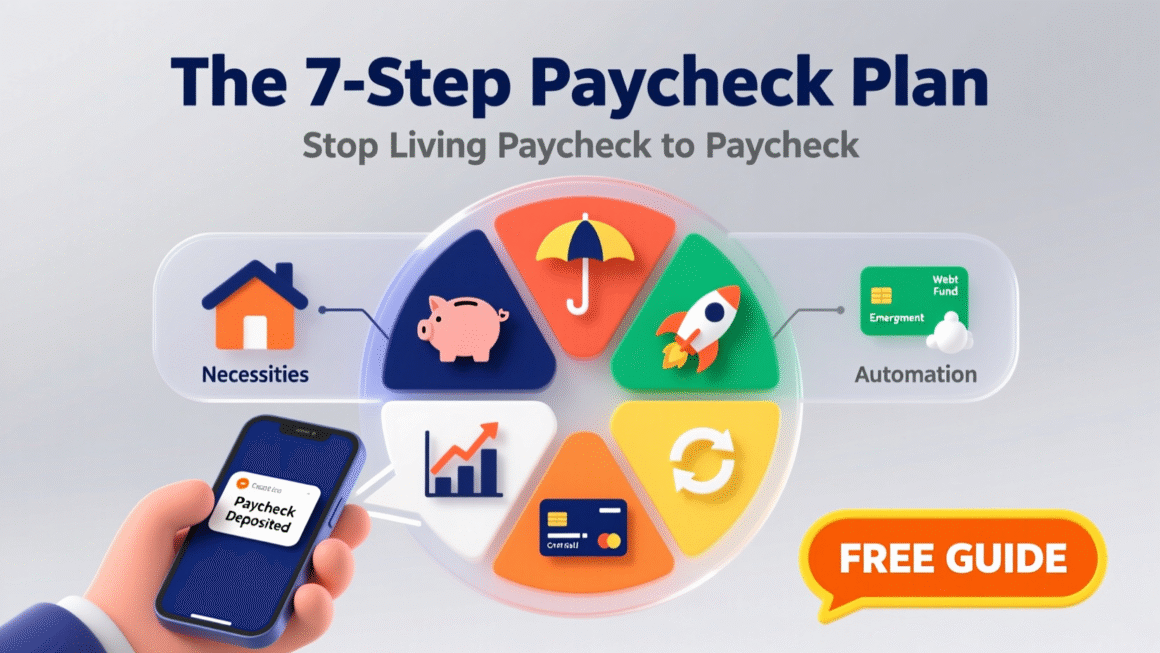








Most people don’t struggle with money because they’re bad at math. They struggle because they don’t have a plan.
Figuring out how to come up with that plan can be overwhelming. There’s so much information and so many conflicting strategies out there, it’s hard to know where to even begin. That’s why we’ve created this structured 90-day plan to reset your finances. By the end of these three months, you’ll have a clear, actionable system for building your wealth and a powerful jump-start on your financial journey.
We’ll cover the essentials: smart investing, how to prioritize your money the moment you get paid, and strategies to save on life’s biggest expenses. This isn’t about a quick fix; it’s about establishing lasting habits.
Let’s begin. Ninety days is roughly twelve and a half weeks, so we’ve broken this reset down into a focused action for each week.
Week 1: The Financial Inventory – Getting Brutally Honest
Before we can fix anything, we need clarity. We must get brutally honest about where our money is going and how much we have coming in.
Every successful business in the world meticulously tracks its revenue and expenses. Walk into any local franchise, and you can be certain they know their daily profit margins intimately. Your financial life should be run with the same operational awareness.
Your action for Week 1:
Gather your last three months of financial statements. Open tabs on your computer for every account: bank statements, credit card bills, loan statements, and any other platform where you’ve spent money. The goal is to see everything visually, in one place.
Next, categorize every single expense into three major buckets:
- Fixed Expenses: Costs you must pay every month (rent/mortgage, utilities, car payments, minimum debt payments, basic groceries, essential subscriptions).
- Discretionary Expenses: Your “wants” (eating out, travel, shopping, entertainment, premium subscriptions).
- Debt Payments (Beyond Minimums): Any extra payments toward principal balances on loans or credit cards.
Ideally, you log this in a simple spreadsheet. The objective is to discover your average monthly spend per category. Once you know your total monthly income, you can easily calculate your savings rate: (Income – Expenses) / Income.
In business terms, you’re figuring out your revenue (income) and your cost breakdown (expenses) to see your net profit (savings). This exercise is illuminating. You may discover you’re spending a startling amount on food delivery or recurring subscriptions for services you never use. This foundational awareness sets the stage for everything that follows.
Week 2: Cutting the Fat – Finding the Easy Wins
With your spending laid bare, Week 2 is about strategic reduction. We focus on the “lowest-hanging fruit” to save the most money with the least pain.
Go through your categorized list and sort expenses from largest to smallest. Analyze each category and ask one critical question: *”Can I reduce this cost by 10-30% over the next 90 days?”*
Let’s consider a hypothetical monthly budget of $4,650:
- Rent ($1,800): Often the hardest to change quickly, but not impossible. Could you negotiate with your landlord, or plan a future move to a less expensive area?
- Car & Insurance ($750): This is prime territory for savings. Most people don’t shop around for insurance regularly. Comparing quotes can easily save $50-$100 per month. Consider if your car payment itself is unsustainable in the long term.
- Ubers ($225): This is a habit-based expense. Identify the trigger—is it weekend lethargy or poor planning? Setting a goal to use public transit or walk for short trips could halve this cost.
- Eating Out & Shopping ($400 & $150): These are discretionary and often elastic. Could you institute a “one less dinner out per week” rule or a 24-hour cooling-off period for online shopping carts? Saving $50-$100 in each category is frequently achievable.
- Subscriptions ($75): Audit them. Cancel anything you haven’t used in the last month. This is pure, painless savings.
The goal isn’t deprivation; it’s conscious spending. If you can find $400 in monthly savings, that’s $4,800 annually. That sum can fund a Roth IRA, a significant debt payment, or a wonderful vacation. It’s money working for your goals instead of vanishing unnoticed.
Week 3: Automate Your Success – Pay Yourself First
Willpower is a finite resource. Automation is your financial superpower.
First, open a high-yield savings account (HYSA) for your short-term savings (goals 1-5 years away). As of this writing, competitive rates are well above traditional bank offers. Earning 4% on your cash is a risk-free return that adds up. $10,000 earning 4% generates $400 per year—just for having your money in the right place.
Next, and most crucially, set up automatic transfers. The concept is “pay yourself first.” When your paycheck hits your checking account, a predetermined portion should immediately be whisked away to your savings and investment accounts before you can even think of spending it.
Here’s a practical example: If you get paid on the 21st, set an automatic transfer for the 22nd to move 10% of your take-home pay. You might send 5% to your HYSA and 5% to your investment brokerage. Psychologically, this works because you never see the money in your daily spending balance. It’s akin to a 401(k) contribution; you learn to live on what remains, and your future self is funded effortlessly.
Week 4: Taming the Debt Dragon
You’re now one-third of the way through the reset. Week 4 is dedicated to creating a battle plan for high-interest consumer debt, primarily credit cards.
If you have credit card debt, your first priority is to understand the total balance and interest rate. Use an online credit card payoff calculator. Input your balance and current payment, then see the impact of adding an extra $50 or $100 per month. The results are staggering—you can shave months or years off your payoff timeline and save hundreds in interest.
Two powerful actions:
- Set up automatic debt payments for more than the minimum. Consistency is key.
- Call your credit card issuer. Politely ask if they can lower your interest rate, even temporarily. Mention you’ve seen competitive offers (do a quick search first). The worst they can say is no, but a successful call can yield an immediate, guaranteed return on your time.
With the average credit card APR over 21%, reducing this rate or accelerating payments offers one of the highest “risk-free returns” you can get.
Week 5: Building Your Financial Moats – The $1,000 Emergency Fund
Financial security begins with a buffer. The goal for Week 5 is to establish or bolster your starter emergency fund to $1,000.
This number is significant. Crossing the four-digit threshold provides a tangible psychological win and a real cushion against life’s small surprises. Consider that a majority of Americans cannot cover a $1,000 emergency. Reaching this milestone puts you ahead of the curve.
To fund it quickly, channel the savings you identified in Week 2, sell unused items online, or take on a short-term side gig. Ensure this fund is parked in your high-yield savings account so it grows while it protects you. If you already have $1,000, your goal escalates to building 3-6 months of essential living expenses.
Week 6: Planting Your Seeds – Start Investing
We’ve reduced spending, automated savings, and addressed debt. Now, we put your money to work. Week 6 is about initiating your investment journey.
Historical data is clear: over the long term, U.S. stocks have provided the highest average annual returns of any major asset class. The key for beginners is simplicity and diversification. The recommended foundation is an S&P 500 index fund or ETF.
An S&P 500 ETF gives you instant ownership in hundreds of America’s top companies with a single purchase. It’s a passive, “set-and-forget” strategy that harnesses the market’s historical average growth.
Your action: Open a brokerage account with a low-cost provider (e.g., Vanguard, Fidelity, Schwab). Allocate a portion of your automated transfers (from Week 3) to this account. Then, schedule regular purchases of an S&P 500 ETF (like VOO or SPY). Consistency is paramount. Investing even $500 a month at an average 8% annual return grows to over $745,000 in 30 years. You’re not timing the market; you’re buying time in the market.
Week 7: Leveling Up – The Income Expansion
You can only cut expenses so far, but your earning potential is theoretically limitless. Week 7 shifts the focus from defense to offense: increasing your income.
Consider these avenues:
- The Direct Ask: If it’s been over a year since a raise, prepare a case based on your contributions and market-rate salaries for your role. The act of asking alone changes the dynamic.
- The Strategic Move: Data shows that strategic job changes every few years can lead to significant salary jumps. Polish your resume and explore the market.
- The Side Hustle: Monetize a skill or time. Freelance, tutor, dog-sit, or manage social media for small businesses. Even a few hundred extra dollars per month accelerates all your goals.
- The Skill Investment: Learn a high-income skill with clear market demand (e.g., data analysis, copywriting, coding basics). Online courses make this more accessible than ever.
By the end of this week, commit to one concrete action that will boost your income in the coming quarter.
Week 8: Defining Your Destination – Setting Written Goals
A dream is just a wish without a plan. In Week 8, you will define and write down your specific savings goals for the rest of the year and beyond.
You already have components: an emergency fund, investment account, and debt payoff. Now, add other goals—a down payment fund, a vacation budget, or next year’s Roth IRA contribution.
Be specific. Instead of “save more,” write: “Save $8,000 for an emergency fund by December 31st.” Then, break it down: “I need to save $670 per month.” This transforms an abstract idea into a manageable monthly target.
Research from Dr. Gail Matthews at Dominican University found that people who write down their goals, share them with a friend, and send weekly progress reports are 42% more likely to achieve them. Write your goals down and tell someone you trust.
Week 9: The Credit Card Conundrum – Know Thyself
Credit cards are a powerful double-edged sword. Week 9 is an honest self-assessment.
If you have self-control: The ideal scenario is to use a rewards credit card for all your planned spending and pay the balance in full, every month, without exception. This strategy earns you cash back, travel points, and builds your credit history without costing a cent in interest. You’re getting free perks funded by the interest payments of the less disciplined.
If you struggle with self-control: Credit cards can be dangerous. The average APR of over 21% turns carried balances into financial quicksand. If you tend to overspend, consider using a debit card or cash until your budgeting muscles are stronger.
A good test is to get a card with a low limit and use it for one recurring bill for 3-6 months. Set it to auto-pay from your checking account. If you can manage that without being tempted to spend more, you may be ready. If not, step back. Responsible use builds excellent credit, but misuse is costly.
Week 10: Tracking Your Trajectory – Calculating Net Worth
Your net worth is the ultimate scorecard of your financial health. It’s a simple but profound number: Assets (what you own) minus Liabilities (what you owe).
Calculating it quarterly provides a long-term view of your progress. For example:
- Assets: House ($300,000), Investment/Bank Accounts ($25,000) = $325,000
- Liabilities: Mortgage ($200,000), Car Loan ($15,000) = $215,000
- Net Worth: $110,000
Tracking this number over time is incredibly motivating. As you pay down debt and your investments grow, you’ll see the line trend upward. Use a simple spreadsheet or a trusted app to snapshot your net worth at the end of each quarter. It turns abstract financial progress into a concrete, rising number.
Week 11: The Accountability Check-In
It’s been roughly eight weeks since your deep spending analysis. Week 11 is a mandatory audit. Revisit your transactions from the last two months. Categorize them again and compare the averages to your pre-reset baseline.
Are your discretionary spending categories still in check? Have new “leaks” sprung? Did the savings you identified in Week 2 actually materialize? This review isn’t about judgment; it’s about course correction. The goal is to catch slippage early and reaffirm your good habits. Spend an hour this week to ensure you’re still on the rails.
Week 12: Vision Casting – Your Stretch Goals
Congratulations, you’ve reached the final phase of the reset. Use these last days to look beyond the horizon. What are your stretch goals?
Think in timelines:
- 1-Year Goal: Save $10,000 for a down payment? Max out an IRA?
- 5-Year Goal: Buy a rental property? Launch a business? Reach a $100k net worth?
- 10-Year Goal: Achieve financial independence? Fully fund your children’s education?
For each, create a backward road map. If a 20% down payment on a $350,000 home ($70,000) is a 5-year goal, you now know you need to save about $14,000 per year, or $1,167 per month. Does that align with your current plan? This exercise turns distant dreams into today’s actionable budget line items.
Finally, schedule your next financial review. Block time on your calendar for a quarterly check-in. On that date, you’ll review your net worth, assess your budget, and track progress toward your stretch goals. This habit ensures the system you’ve built lasts a lifetime.
The Journey Ahead
This 90-day reset is a catalyst, not a conclusion. True wealth isn’t built overnight; it’s built through the consistent, disciplined application of these fundamental principles. You now have a system: you track, you automate, you invest in yourself and the market, and you regularly review.
The path to financial control is clear. It requires patience, persistence, and a long-term vision. You’ve laid the groundwork. Now, move forward with confidence, knowing that each small, consistent action is compounding into a more secure and prosperous future. The reset is complete. Your financial journey has just begun.