



The $40 Billion Argentine Bailout: A Secret Fund, Wall Street Bets, and the New Financial Cold War
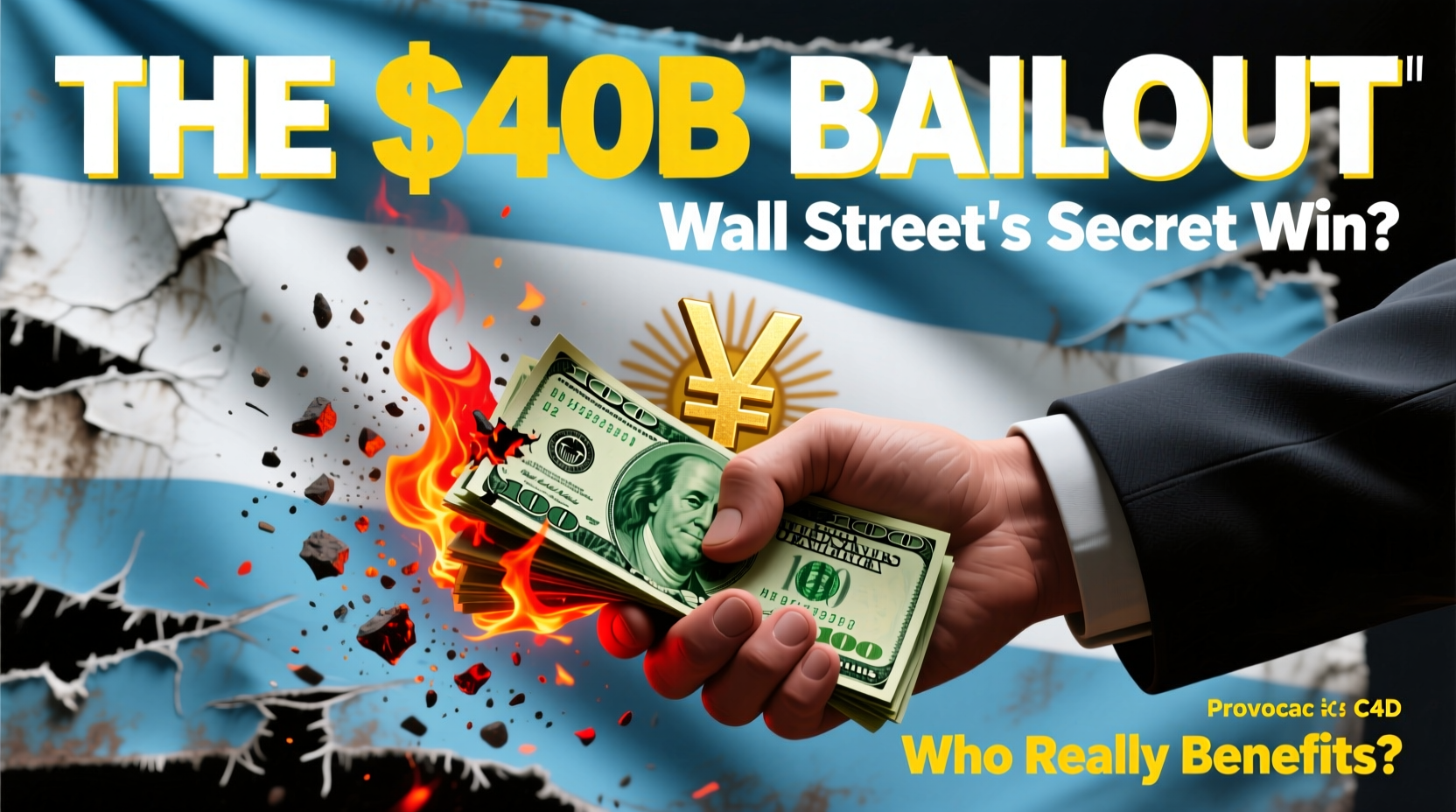
The United States government is in a shutdown. Debates over spending and the debt ceiling have brought federal operations to a screeching halt. And yet, in the midst of this domestic fiscal paralysis, the U.S. Treasury has quietly committed $40 billion to bail out the economy of Argentina.
This is not a theoretical exercise. The Treasury is actively buying Argentine pesos, a currency that has hyperinflated, losing over 200% of its value. We are told this is a sound investment. The political rhetoric is that Argentina’s president, Javier Milei, represents “MAGA all the way,” and that this partnership is about supporting a fellow traveler in free-market philosophy.
But the facts on the ground tell a more complicated story. Argentina is not a top-tier trading partner for the U.S.; it doesn’t crack the top five, or even the top ten. This massive financial intervention was never debated on the floor of Congress. It wasn’t voted on. It barely caused a ripple in the mainstream news cycle. Officials are adamant: this is not a bailout.
So, the pressing questions remain: Why are we doing this? Where is this money coming from? And what does this maneuver reveal about the underlying forces shaping the global economy?
The answers lead us down a rabbit hole of a little-known government fund, powerful Wall Street interests, and a new, silent financial war between the United States and China.
The Mystery of the Exchange Stabilization Fund
To understand how this was possible without Congressional approval, we must look to a financial instrument most Americans have never heard of: the Exchange Stabilization Fund (ESF).
The ESF is a creature of a different era. It was created in 1934 during the depths of the Great Depression, born from a moment of profound government power over money. President Franklin D. Roosevelt, in an effort to stimulate the economy, dramatically revalued gold, raising its official price from $20.67 to $35 per ounce. Overnight, the U.S. government declared its gold reserves to be worth 70% more.
This repricing generated a massive, multi-billion dollar paper profit for the Treasury. Rather than handing this windfall to Congress to spend, Roosevelt and his administration sequestered it into a new, secretive fund. The ESF’s mandate was broad and powerful: to intervene in currency markets to stabilize the dollar, and, crucially, to influence foreign economies—all without ever needing to ask Congress for permission.
For nearly 90 years, this fund has sat inside the Treasury, a dormant financial weapon used only in moments of extreme crisis. It was deployed in 1995 to bail out Mexico during the “Tequila Crisis.” It was activated again in 2008 during the global financial collapse to backstop money market funds. And it was used during the pandemic when the Federal Reserve had run out of conventional tools.
Now, it is being used to prop up the Argentine peso and, by extension, the entire Argentine economy.
But how does it work? Is this simply U.S. taxpayer money being wired to Buenos Aires? The mechanism is more nuanced, though the risks are no less real.
The Treasury isn’t writing a blank check. It is engaging in a “currency swap” through the ESF. In simple terms, the Treasury buys Argentine pesos from Argentina’s central bank, giving them U.S. dollars in return. The pesos act as collateral. In practice, however, the U.S. Treasury is now holding a massive quantity of a hyperinflating currency—a melting ice cube—on behalf of the American public.
The first $20 billion of this package comes directly from the ESF. The second $20 billion is expected to be sourced from private investors, hedge funds, and sovereign wealth funds. Why would these private, profit-seeking entities participate in such a risky venture? The answer is simple: because the U.S. Treasury is guaranteeing the security of their investment. The full faith and credit of the United States is backstopping their bet.
Are U.S. taxpayers directly on the hook today? Not immediately. But if Argentina defaults and cannot repay the dollars, the loss is absorbed by the ESF. A depleted ESF represents a loss to the Treasury’s balance sheet, a shortfall that would ultimately be filled by issuing new debt—debt that taxpayers, in the long run, are responsible for servicing.
The Official Story: A Battle for Influence and the Dollar’s Throne
So, why Argentina? If the goal is global economic stability, there are countless nations in distress. The official explanation, articulated by Treasury Secretary Scott Bessant, is one of grand strategy.
Secretary Bessant, a former macro investing legend who managed billions for one of history’s most successful hedge funds, has been vocal about one core mission since taking office: the United States must reclaim its leadership role in global finance. He argues that for decades, America has ceded ground to the International Monetary Fund (IMF), the World Bank, and most significantly, China.
China has been on a lending spree across the developing world, particularly in Latin America, using its state-owned banks to fund infrastructure projects and pull nations into its economic orbit. This is part of a long-term project of “de-dollarization,” an effort to challenge the U.S. dollar’s status as the world’s primary reserve currency.
Secretary Bessant’s reasoning is that Argentina represents a perfect test case. It is a nation with immense potential—vast reserves of natural gas and lithium, fertile farmland—but it is crippled by catastrophic monetary policy, with inflation over 200% and a history of sovereign defaults. By stepping in to stabilize the peso, the U.S. can accomplish two goals simultaneously: it can rescue a potential ally from collapse and, in doing so, protect the dollar’s influence in a region where China is making significant inroads.
The framing is one of a “currency stabilization partnership,” not a bailout. It is portrayed as a strategic investment in a like-minded government, a bulwark against Chinese expansion, and a defense of the dollar’s global reign.
The Unofficial Story: Cui Bono? Who Benefits?
However, when a story seems too neat, it often pays to ask the oldest question in politics and finance: Cui bono? Who benefits? Following the money reveals a network of connections that paints a more troubling picture.
The more one looks, the more one notices profound links between Wall Street, the current U.S. Treasury leadership, and a handful of powerful investors with deep, distressed interests in Argentine debt.
For years, several major hedge funds have been placing massive bets on an Argentine recovery. They loaded up on the country’s sovereign bonds, which were trading as “distressed debt”—a polite term for debt the market believes may never be repaid. Argentina’s bonds maturing in 2035 and 2041 were, at one point, trading as low as 25 to 35 cents on the dollar. This is a bet of sheer speculation, a wager that a miracle turnaround was possible.
Their bet was predicated on the election of President Javier Milei. He ran on a platform of radical economic reform—taking a “chainsaw” to public spending and bureaucracy. The funds wagered that if Milei could fix the economy, these nearly worthless bonds would soar in value.
But the miracle did not materialize. Inflation remained stratospheric, the peso continued its collapse, and the value of those bonds fell another 30%. The portfolios holding them were bleeding billions.
Now, fast forward to the present. The U.S. Treasury, led by Secretary Scott Bessant, steps in with a $40 billion lifeline. The official reason is to counter China and defend the dollar. But a direct consequence of this intervention is that it throws a lifeline to those very same distressed bonds. By stabilizing the Argentine economy and the peso, the Treasury’s action directly increases the likelihood that Argentina will be able to service its debt, saving the billionaire investors who placed a bad bet.
The connections here are striking. The current Treasury Secretary, Scott Bessant, spent decades in the world of high-stakes macro investing. He previously worked under George Soros at the legendary Quantum Fund, managing billions alongside the very individuals who now run funds with enormous exposure to Argentine debt. Funds like Discovery Capital, founded by a former Soros fund manager, and Soros Fund Management itself, are among the largest holders of this distressed paper.
This does not imply illegality. But it presents a staggering coincidence: the person now approving a $40 billion deal that salvages Argentine debt is the same person who spent a career making money from precisely these kinds of trades, and who has deep, longstanding professional ties to the people on the other side of this trade.
The behavioral reality is that of a bailout for Wall Street, cleverly reframed as a strategic foreign policy initiative. And the costs are not abstract. American cattle ranchers are already speaking out, warning that plans to import cheaper Argentine beef to control U.S. meat prices will devastate their industry. In essence, on a practical level, American producers and taxpayers are being positioned to subsidize both a foreign competitor and the private investors who gambled on its recovery.
The Bigger Picture: A New Financial World War
Ultimately, the Argentine bailout cannot be understood in isolation. It is a single battle in a much larger, undeclared war over the future of the global financial system.
On one side, China is aggressively building a parallel system. Its “Belt and Road Initiative” is more than an infrastructure program; it is a network of financial influence. China is establishing a “gold corridor”—a network of vaults across Asia, Africa, and Latin America—and is promoting a yuan that is increasingly seen as being backed by tangible gold reserves. They are offering an alternative to a dollar-based system built on U.S. Treasury debt.
The United States is responding with offensive defense. The bailout of Argentina is a signal, a demonstration of power. It telegraphs to the world that the U.S. still possesses the will and the means to stabilize economies, even from a position of domestic political dysfunction. The message is: China lends in a gold-backed yuan, but we lend in dollars backed by the full might of the American economy. Argentina is the testing ground because it is a Latin American nation that has been steadily drifting into China’s sphere, accepting billions in loans for power plants, railways, and nuclear projects.
If this strategy is deemed a success, we should expect to see it replicated. The blueprint is now in place. There are already rumors that other nations drowning in debt to China and facing currency crises could be next in line for a “currency stabilization partnership.” Countries like Brazil, a BRICS nation that owes tens of billions to Chinese state banks; Colombia, whose peso has fallen precipitously; or Egypt, one of China’s largest African borrowers and perpetually on the verge of an IMF rescue.
This is not without precedent. The 1995 Mexican bailout was executed for similar reasons: to prevent financial chaos from spilling over the border. But the context today is fundamentally different. The world is no longer unambiguously on the dollar standard. We are witnessing the early stages of a bipolar financial world.
The U.S. is fighting to maintain its supremacy, and in doing so, it is engaging in actions that blur the lines between statecraft and market manipulation. It just so happens that this fight also provides a convenient mechanism to rescue the failed bets of some of the most powerful and well-connected financial entities in the world.
The $40 billion Argentine intervention is far more than a loan to a struggling nation. It is a window into a new era of financial geopolitics, where the tools of economic statecraft are wielded in the shadows, and the lines between national interest and private gain have become dangerously blurred.