







The stock market is dancing at all-time highs, yet a quiet unease is spreading through the financial world. If you have any money invested whatsoever, you’ve likely felt this tension—the thrilling ascent of your portfolio tempered by a nagging question: is this sustainable?
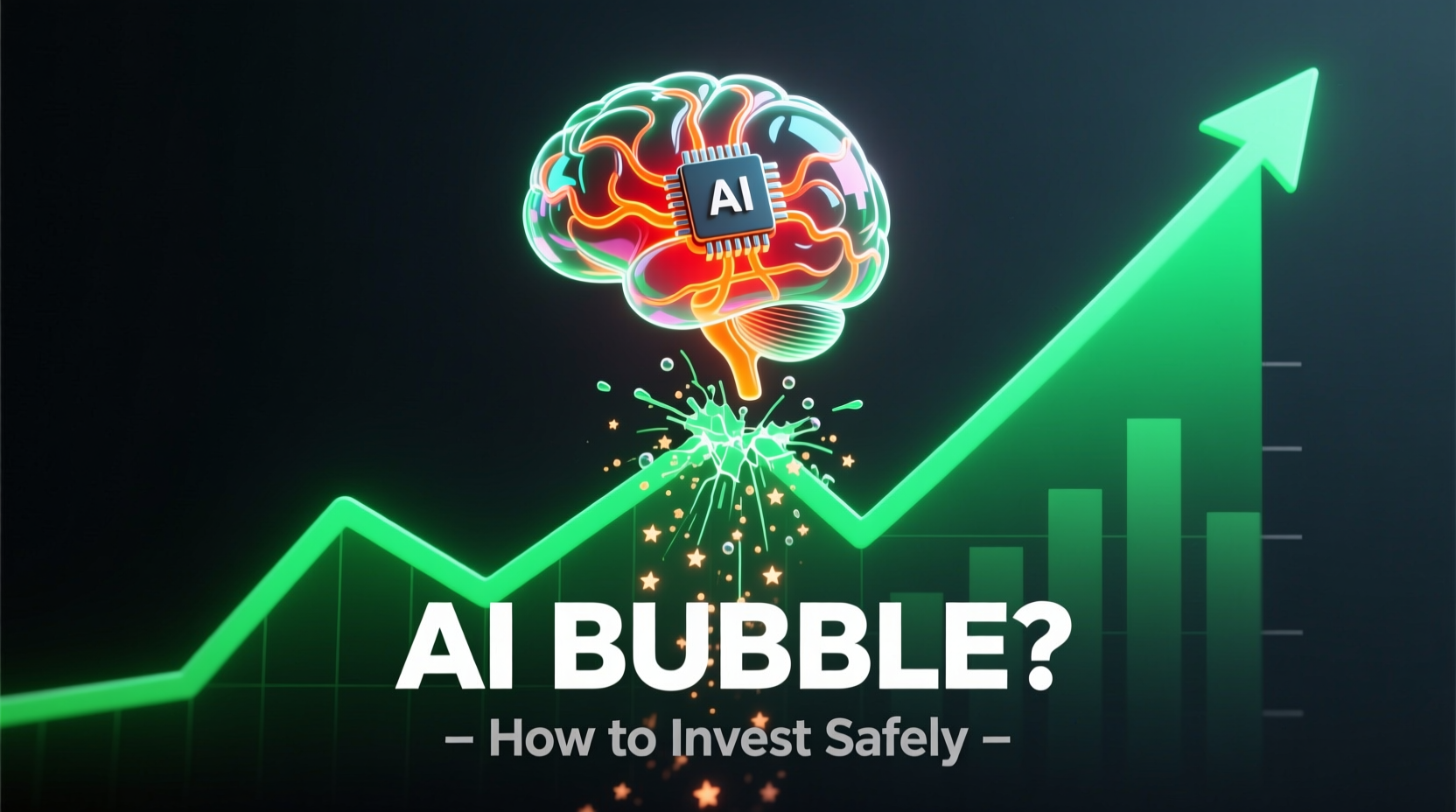
This anxiety isn’t baseless. Recent data shows that search volume for the term “AI bubble” has just shattered previous records. A growing cohort of investors is convinced the economy is on borrowed time, and their concerns are echoed by some of finance’s most respected voices. Billion investor Paul Tudor Jones has gone so far as to say the current environment is reminiscent of the period immediately preceding the 2001 dot-com crash.
It’s a conversation we need to have. It’s easy to get swept up in the narrative that stocks only go up and that AI is an unstoppable force. However, the reality is that many portfolios are not built to withstand a sudden turn in the tide. The prospect of seeing years of careful gains evaporate in a matter of weeks is a sobering one. Today, we’ll dissect what’s truly happening in the markets, explore what the future might hold, and outline a strategy designed for stability, not just speculation.
The Anatomy of a Modern Frenzy
At its core, a market bubble forms when unchecked enthusiasm, rampant speculation, and easy capital converge, causing a specific sector—or the entire market—to detach from underlying economic realities. What we are witnessing today in the artificial intelligence space is a case study in this phenomenon.
Consider the circular flow of capital that has emerged. OpenAI recently secured a valuation approaching a staggering figure, and in turn, committed hundreds of billions to Oracle for cloud computing power. This sent Oracle’s stock soaring, a company whose infrastructure is heavily reliant on Nvidia’s chips. As demand for these chips explodes, Nvidia’s revenues and market cap reach astronomical heights, enabling it to reinvest vast sums back into AI pioneers like OpenAI.
If this sounds a bit like a self-perpetuating loop, that’s because it is. To simplify, it brings to mind a scenario where Paul invests $100 in John, who then invests $100 in Bob, who circles back and invests $100 in Paul. The money moves, creating a perception of immense value, but the fundamental, external validation of that value remains unclear.
This leads us to the first hard data point. As of now, the technology sector’s weighting within the S&P 500 index has surpassed its peak level from the height of the 1999 dot-com bubble. Meanwhile, Nvidia, one of the primary engines of this rally and now one of the most valuable companies in the world, trades at a price-to-earnings (P/E) ratio north of 50. This means investors are paying over fifty times what the company earned in the last year, a clear bet that future profits will be so monumental that today’s premium price will eventually look like a bargain.
The Buffett Indicator: A Sobering Gauge
Beyond individual stocks, we can look at broader market metrics. One of the most cited is the “Buffett Indicator,” named for the famed investor Warren Buffett who once referred to it as “the best single measure of where valuations stand.” This indicator compares the total market capitalization of all US stocks to the country’s Gross Domestic Product (GDP).
The general interpretation is straightforward:
- 70%: Stocks are considered significantly undervalued.
- 100%: Fair value.
- 200%+: A strong warning sign that the market is dangerously overvalued.
So, where are we today? The Buffett Indicator is currently trading at a reading above 217%. This places it at the highest level ever recorded in stock market history, eclipsing the peaks of 2001 and 2008.
To be fair, some analysts argue the indicator is somewhat flawed in a modern context, as it doesn’t fully account for the impact of historically low interest rates on company valuations. Yet, this extreme reading is still a powerful signal that cannot be ignored. It suggests that the market’s collective price tag is profoundly disconnected from the current output of the underlying economy.
The concentration of this growth is another red flag. The top ten companies in the S&P 500 now constitute more than 40% of the entire index’s value. This means that even an investor who believes they are broadly diversified through an index fund has a significant portion of their capital riding on the fortunes of less than a dozen corporations.
Echoes of the Past: Dot-Com and the Japanese “Everything Bubble”
To understand our potential future, we must look to the past. The dot-com crash of 2001 is the most frequent comparison for today’s market. It was fueled by a frenzy of speculation around internet-based companies throughout the late 1990s. The narrative was identical: the internet was the future, and to miss out was to be left behind. The reality, however, was that capital was being thrown at companies with no profits, shaky business models, and in some cases, no revenue at all. When the euphoria subsided, the collapse was brutal. Investors in tech stocks at the peak lost, on average, 78% of their capital, and it took nearly two decades for some to recover their losses.
There are crucial differences, however. In 1999, the NASDAQ’s P/E ratio soared as high as 75, compared to today’s more moderate, though elevated, 35. The poster child of the dot-com era, Cisco, peaked at a valuation of 472 times earnings—dwarfing even Nvidia’s current premium. By these specific measures, the current bubble is not as inflated as its predecessor.
But the underlying psychology is disturbingly similar. We are once again seeing a surge of investment in companies with no measurable return on investment. A recent MIT study found that a staggering 95% of companies saw no tangible productivity gains from their AI investments. This points to a growing divergence between massive capital investment and actual productivity return—a hallmark of a speculative mania.
This is why some observers are also drawing parallels to the Japanese “Everything Bubble” of the late 1980s. During this period, the Japanese stock market tripled in a few short years. So much capital flooded the system that the Cyclically Adjusted Price-to-Earnings (CAPE) ratio for the Japanese market reached an almost unimaginable 80—nearly double the dot-com peak. The aftermath was a “lost decades” of economic stagnation. The market fell 80%, deflation set in, and it took nearly 40 years for the country to fully recover.
While the U.S. market is not as broadly overvalued as Japan’s was, the same psychological drivers are present: a belief in a “new economic paradigm,” overconfidence in a specific technology (AI), rampant liquidity, and a return of pure speculation.
Challenging the Narratives: The Dollar and Inflation
In defense of the current market, some argue that high asset prices aren’t the result of a bubble, but rather the symptom of a declining U.S. dollar. The theory goes: if the dollar is losing value, it takes more of them to buy the same stock, so prices naturally rise. Others point to inflation from years of monetary stimulus as the true culprit.
When we examine the data, however, these theories don’t hold up well over the long term. Looking at the U.S. Dollar Index over the last half-century reveals wild swings—periods of sharp depreciation from 2002-2012, followed by a strong appreciation throughout the 2010s. Throughout all this volatility, the stock market had its own independent trajectory, rising and falling with no consistent correlation to the dollar’s strength.
Analysis from firms like Fisher Investments, looking back to the 1970s, confirms this. The correlation between the trade-weighted dollar and S&P 500 returns is a negligible 0.15, which is effectively zero. Their research also shows that global stocks have been positive 76% of the time, regardless of whether the dollar was rising or falling.
As for inflation, while it can certainly impact stock prices in the short term, there is no proven long-term correlation between the amount of money printed and the level of the stock market. As financial blogger Ben Carlson has pointed out, this may be because the market is inherently forward-looking, while inflation data is backward-looking. Even predictive models fail to show a reliable link. This suggests that the market’s expansion is, to a significant degree, genuine and not solely a phantom created by a devalued currency.
The Unanswerable Question: Are We in a Bubble?
So, we arrive at the central question: are we definitively in a stock market bubble?
The honest answer is that by nearly every classical measure of valuation—the Buffett Indicator, sector concentration, P/E ratios—the market is trading at historically high levels that are difficult to justify based on current economic fundamentals. The fear is palpable in the data: 60% of venture capital is now flowing into AI, eclipsing the 40% that went into internet companies in the late 1990s.
But could this time be different? There is a compelling case to be made.
If we were truly at a bubble peak on par with Japan in 1989, the S&P 500 would be trading above 11,000, nearly double its current level. Furthermore, there is an estimated $7.7 trillion in cash still sitting on the sidelines, waiting to be deployed. Unlike the fly-by-night dot-com startups, today’s AI revolution is being led by some of the most profitable and resilient companies in history—Google, Microsoft, and Amazon. These are not companies that will vanish overnight if an AI project underperforms.
We also cannot deny the potentially transformative nature of artificial intelligence. It is a genuine technological shift, and it is entirely possible that corporate earnings will grow into their current valuations. Amazon itself is a prime example; it survived the dot-com bust as a unprofitable company and grew to become a titan. The very fact that everyone is openly discussing a bubble might itself be a contrarian indicator, suggesting that widespread caution is already baked into prices.
A Prudent Path Forward: Strategy in an Uncertain Time
Given this conflicting evidence, what is a rational investor to do? The key is to acknowledge the uncertainty and build a portfolio that can withstand multiple outcomes.
The famous warning that “the market can remain irrational longer than you can remain solvent” is paramount. Betting against a rising market has been a recipe for financial ruin for centuries. Consider the cautionary tale of Isaac Newton during the South Sea Bubble of 1720. He invested early, sold for a handsome profit, and wisely concluded the market was insane. But as prices continued to soar, he watched his peers get richer. Succumbing to FOMO (Fear Of Missing Out), he plunged back in at the peak and lost a fortune when the bubble inevitably burst. His brilliance was no match for market mania.
Learning from this history, my approach centers on disciplined diversification and consistent investing, regardless of market conditions.
- Dollar-Cost Averaging: I am a huge proponent of consistently investing a fixed amount of money at regular intervals. This strategy removes emotion from the process and ensures you buy more shares when prices are low and fewer when they are high, smoothing out your average cost over time.
- Radical Diversification: True diversification means looking beyond the S&P 500. My own strategy involves:
- U.S. Stocks: Maintaining a core position, but being mindful of sector weightings.
- International Stocks: Allocating a portion to developed international markets and emerging markets, which offer different growth drivers and valuation levels.
- Alternative Assets: A small, strategic allocation to assets like a Bitcoin ETF can provide a non-correlated hedge, though this comes with its own significant risks.
- Cash and Cash Equivalents: Keeping a portion of my portfolio in “dry powder” is crucial. I hold a segment in tax-free municipal bonds, which currently yield between 3.5% and 5% annually. This serves as both a source of stability and a reserve fund to deploy during any significant market downturn.
This multi-pronged approach is a form of insurance. Yes, holding cash means potentially missing out on some gains during a continued bull run. But if the market corrects, that dry powder will allow me to buy high-quality assets at a discount, an opportunity that more than pays for the temporary drag on performance.
The Final Verdict
From everything we can observe, the data points to a market trading at a very high level—one that may be difficult to sustain without a period of consolidation or correction. The signs of speculation are present, and historical parallels are too striking to dismiss.
However, that does not mean this rally cannot continue for weeks, months, or even years. The transformative potential of AI is real, and the fundamental strength of the market’s leaders is undeniable. Statistically, betting against the American economy and its innovative capacity has been a losing game in the long run.
Therefore, the optimal strategy is not to predict the future, but to prepare for it. Ensure you have a steady income, invest consistently, and build a truly diversified portfolio. This way, you can participate in the potential upside while being insulated from the worst of the downside. The goal is not to be the smartest person in the room calling the top, but to be the most prepared person for whatever comes next.