







The Silent Epidemic of Financial Fear
I’ll never forget a session I led back in 2016 on our relationships with money. I was simply curious about where people were on their financial journeys. We had about fifty people in the room. We circled up and went around, each person sharing just something—anything—about their personal relationship with money.
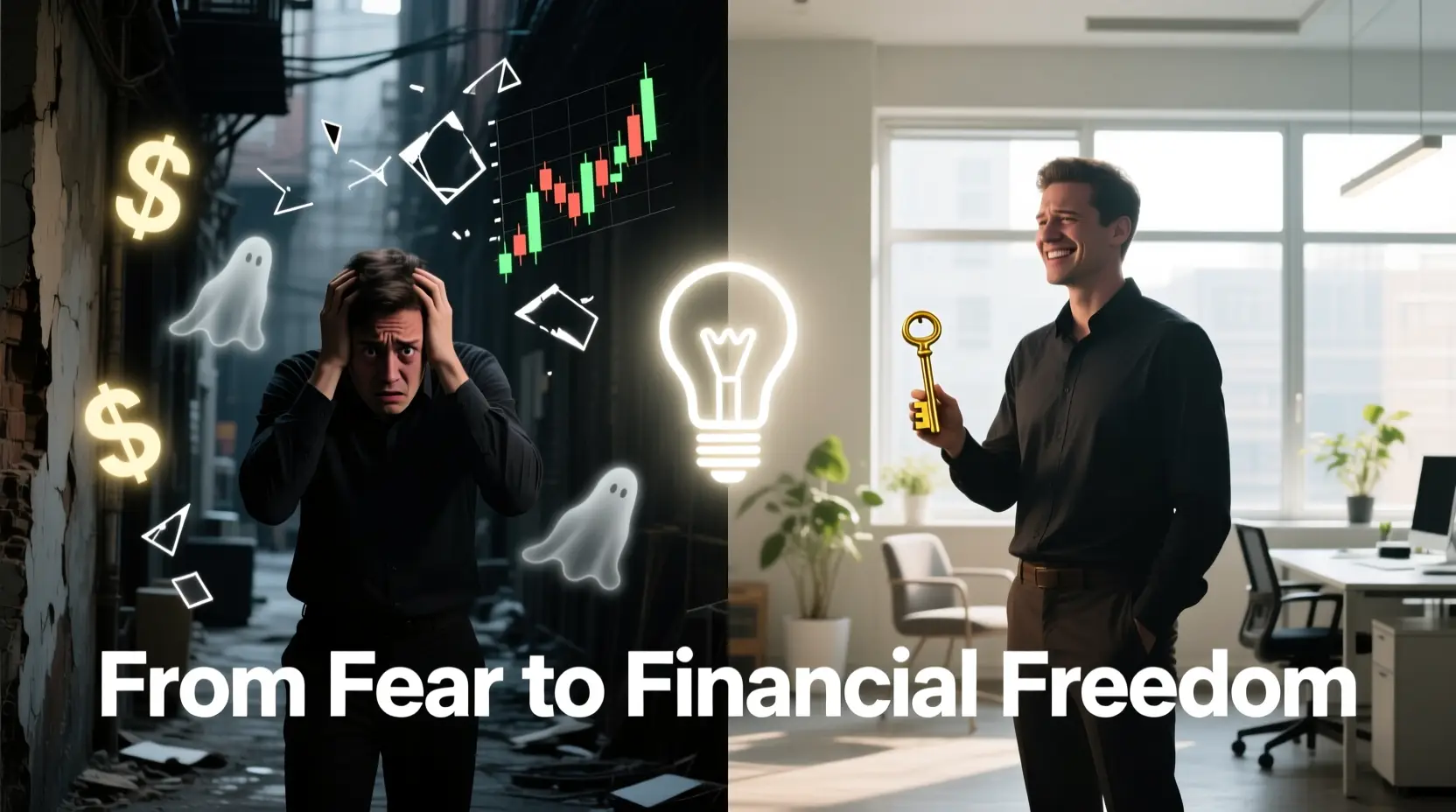
What I heard, one after another, was a chorus of fear.
It didn’t matter who was speaking. The eighty-year-old who I knew for a fact had millions in the bank spoke with the same underlying tremor in their voice as the twenty-year-old who was already $20,000 in debt. From the seemingly secure to the openly struggling, every single person was navigating their financial life from a place of anxiety.
And honestly, it infuriated me. What kind of society have we built that requires everyone to participate in a system that, on some fundamental level, terrifies them? This felt so profoundly amiss, so contrary to what a healthy relationship with the resources in our lives should be.
This universal fear isn’t a personal failing; it’s a symptom of a deeper issue in how we’re taught to think about money. We’re thrown into the deep end of the economy without being taught how to swim, and then we’re made to feel it’s our own fault when we’re gasping for air. The anxiety becomes a background hum, a constant, low-grade static that influences every decision, from the grocery store to the career path we choose. We start to believe that this is just how money is—something to be worried about.
But what if we could quiet that static? What if the problem isn’t the money itself, but the mental frameworks we use to understand it?
Why Our Financial Instincts Betray Us
This widespread financial anxiety is deeply tied to the quirks and shortcuts of the human mind. As the renowned psychologist Daniel Kahneman explains, “People are not fully rational, and they make many choices that if they reflected upon them, they would do differently. There’s no question about that.”
The core of the issue, he points out, is a tendency he calls “narrow framing.” We take a dangerously narrow view of our financial decisions. We look at the problem right in front of us—an unexpected car repair, a desire for a new gadget, a dip in the stock market—and we deal with it as if it were the only problem in a vacuum.
We don’t see our financial life as a cohesive, interconnected whole. A classic example? “People will save and borrow at the same time,” Kahneman notes. They might have $5,000 sitting in a savings account earning a paltry 0.5% interest while simultaneously carrying $3,000 on a credit card at 20% interest. They frame the savings as their “safety net” and the debt as a “necessary evil,” never merging the two in their mind to see the obvious, net-negative financial picture.
“The major tendency is people tend to frame things very narrowly,” Kahneman says. “They take a narrow view of decision making. They look at the problem at hand and they deal with it as if it were the only problem. Very frequently, it’s a better idea to look at problems as they will recur throughout your life and then you look at the policy that you’re to adopt for a class of problems. Difficult to do, but it would be a better thing.”
If we could learn to step back and take this broader, “whole-life” view, we would consistently make better decisions. We’d see that the goal isn’t to solve today’s financial itch, but to create a resilient system for our future selves. This shift from a narrow, reactionary mindset to a broad, strategic one is the first, crucial step out of the fog of fear and into the clarity of control.
The Four Layers of Financial Independence: A Practical Path to Sovereignty
So, how do we make this shift? How do we move from being passive, anxious participants in the economy to active, confident architects of our financial lives? I believe it happens by building what I call the “Four Layers of Financial Independence.” Notice I said “independence,” not just “freedom.” There’s a vital distinction.
First of all, I’d like to distinguish between independence and freedom. So, financial freedom is like freeing your mind. Financial freedom is understanding that I’m me and there’s an economy out there, and I have a relationship with it, but it doesn’t run my life. It’s freeing my mind from the messages of the consumer culture, the messages of the economy.
It’s questioning the relentless messaging that tells you a house is a “starter house.” No, that’s my house. I could die in my house! It’s pushing back against the so many presumptions that drive us into waste, slavery, and debt. And it doesn’t matter whether you are at the low end or the high end of the income spectrum. If you are engaged in that sort of anxious, striving process of more, more, more, you are not free. You’re on a treadmill, not a path.
With that in mind, here are the four layers:
Layer 1: Sovereignty of the Mind
This is the foundational layer, the “freeing your mind.” It’s the conscious decision to say, “I am sovereign. The economy is secondary.” It’s the realization that you are the protagonist of your own life, not a minor character in the economy’s story. You will move your sovereign self into the economy for your own purposes, rather than seeing yourself as a schlump, where the economy is your mega-boss, as big as the sky, and you just let your life be run by this invisible, intimidating force. No. This layer is about reclaiming your internal authority. It costs nothing but attention and courage.
Layer 2: Get Out of Debt
Once your mind is your own, the next practical step is to break the chains of debt. For many, debt feels endless, a life sentence. The absolute, non-negotiable first step is to stop going into debt. It’s like trying to bail out a boat without first plugging the holes. I’ve heard from countless people who have written to us who flattened what they thought was “impossible” debt in a couple of years. Debt that was going to follow them to the grave. How? They made the powerful link between their debt and the actual opportunities—the future experiences, freedoms, and choices—it was stealing from them. Once something in the future becomes more important than the immediate, fleeting pleasure of buying one more tchotchke you’re never going to use, the motivation becomes internal and powerful.
Layer 3: The Buffer of Liquid Savings
The third level is to build that crucial buffer: six months of essential living expenses in liquid assets. This means money in a bank account or someplace where you can access it within 24-48 hours. This is your emergency fund. Its sole purpose is to ensure that when life happens—as it inevitably will—you are not instantly tumbled back into debt. You lose a job, your car transmission fails, you have a medical emergency. This fund is your peace of mind. In a world where even very significant jobs feel precarious, this layer is how you personally opt-out of that pervasive precariousness. Part of how you get out of that zone is savings. It’s the antidote to financial panic.
Layer 4: Cultivating Passive Income
Over time, the final layer emerges naturally from the third. You start to see that surplus savings—money beyond your emergency fund—can be invested in such a way that it throws off an income. This is where you transition from a saver to an investor. You become a systematic, and sometimes even obsessive, saver. You can chart it. You can watch your passive income grow, knowing that this money represents your life energy, wisely deployed. You track your spending not as an act of penny-pinching, but as an act of self-awareness, ensuring your life energy is aligned with what you truly value. An easy way to do this, if you don’t like writing in a little notebook, is to just use your debit card (I said debit, not credit). Your bank does the tracking for you. Every month, you review your purchases, sort them into categories that reflect your lifestyle, and you tell yourself the truth about whether spending your life energy in that way genuinely contributed to your happiness and purpose.
The Two Pillars of Smart Money Management
Building these layers requires a certain mental discipline, a marrying of the head and the heart. Daniel Kahneman’s insights are invaluable here. He points to two essential pillars for sound financial decision-making.
“First of all, you need to be numerate,” he states. “Numerate people have a significant advantage over those who are not.” This isn’t about advanced calculus; it’s about grasping fundamental concepts that have an outsized impact on your life. “Understanding compound interest makes a huge difference, whether you’re a credit card borrower or somebody with savings.” People often have a very hazy idea of how compound interest works, and that vagueness is incredibly detrimental. Knowing whether it’s working for you (in investments) or against you (in debt) is non-negotiable.
The second pillar is that broader framing we discussed earlier. “Then you need to frame things broadly… By taking the broad view, it is very important not to have overly strong emotional reactions to events.” What does this mean in practice? It means that most of us are wired to respond viscerally to every single gain and loss, every market fluctuation, every unexpected bill. But you’re far better off if you can adopt a longer-term perspective, where you think, “You win a few, you lose a few,” and you consciously limit your emotional response to small, short-term gains and losses. A market dip isn’t a catastrophe; it’s a blip in a decades-long journey. An unexpected bonus isn’t a lottery win; it’s a tool for your broader goals. This emotional regulation, born from a wide-angle view, is what prevents panic selling and impulsive buying.
Money Can Buy Happiness—But Only If You Spend It Right
So much of our financial anxiety is rooted in a deep, unexamined belief that more money will finally make us happy and safe. We project onto money the ability to not only make us comfortable but to make us better—better than other people, more secure, more worthy. All these deep, gut-level emotional feelings play themselves out in our relationship with our bank accounts.
As Michael Norton’s research highlights, we have these two parallel desires: “We want more money and we want more happiness so maybe if we get more money we’ll get more happiness.” It seems like a simple equation. But the reality is far more complicated. We’ve all heard the old adage that “money can’t buy you happiness,” but that’s not entirely helpful. It doesn’t guide us toward understanding what kind of spending will actually contribute to our well-being and what kind won’t.
This forces a profound existential question. We have a certain limited time on this planet. We’re going to spend a third of it sleeping. We’re going to spend another third of it commuting, showering, sitting at a desk, and doing somebody else’s bidding. That doesn’t leave a lot of life that feels truly our own. You think, I’ve got a third—a third of my waking hours are mine. So, who am I in that time? What do I care about? What impact do I want my actions to have? What do I want to learn, to understand, to feel, to taste, to touch? What do I want in what the poet Mary Oliver so beautifully called my “one wild and precious life”?
Norton’s data provides a clear, and perhaps surprising, answer. “The biggest category of things that people spend on is stuff for themselves,” he says. Of course, we need the basics—shelter, transportation, food, clothing. “But it seems as though people are spending an inordinate amount of their money on stuff for themselves. And the biggest problem… is the percent of money that you spend on stuff for yourself is completely uncorrelated with how happy you are with your life.” It doesn’t make you unhappy, necessarily. It’s just… flat. No matter how much you buy for yourself, nothing really seems to happen to your baseline happiness.
The magic happens when we shift our spending focus. “When you focus on other people,” Norton explains, “you sort of reverse the arrow from me to you.” Whether it’s giving to charity, treating a friend to lunch, or buying a thoughtful gift, these actions of giving, rather than keeping, are consistently associated with more reported happiness.
The other powerful shift is from stuff to experiences. You can still spend on yourself, but change what you’re buying. “Lots of research over the last decade has shown that on average when people buy experiences, it tends to pay off in more happiness than buying stuff for themselves.” Why? Often, when we buy stuff for ourselves, we end up by ourselves with our stuff—think of yourself on your phone, playing a video game, alone in a room. Experiences, however, are inherently social more often than not. Going out to dinner, seeing a movie, going on a hike—these activities have other people built into them. “It turns out that talking to other people makes us happy. Even casual interactions with other people make us happier than sitting by ourselves in a room.”
This isn’t just theory. In my experience, once people start to pay attention to the flow of money and stuff in their lives through this lens, their consumption often drops naturally by about 20-25 percent. That’s the amount of unconscious, autopilot spending that falls away when you simply bring awareness to it. People often tell me they don’t even know what they used to spend that money on. They just paid attention and asked one simple question before each purchase: “Is this truly adding to my happiness?”
The Most Important Conversation You’re Not Having With Your Kids
If we want to break the cycle of financial fear for the next generation, we have to start early. The statistics are staggering. As Bruce Feiler found, “Eighty percent of children—eight, zero—get to college having never had a conversation with their parents about money.” They are launched into the world without understanding where money comes from, how it’s earned, how it’s spent, or what debt really is. We give them the keys to the car but never teach them the rules of the road.
In search of wisdom, Feiler went to what he thought would be the ultimate source: the bankers who advise Warren Buffett’s family and the wealthiest families in America. Surely, they would have it all figured out. The surprising revelation was that these ultra-wealthy families were often making even bigger mistakes, their silence creating a different kind of burden for their children.
He walked away with several powerful takeaways that apply to every family, regardless of income:
- Show Them the Money: It is incredibly important to talk to children about money at an age-appropriate level. Silence breeds mystery and anxiety. One of Buffett’s bankers told Feiler about a conversation with one of the richest women in America, who said, “It’s a burden if I tell my children how much money they have.” The banker’s profound reply was, “It’s much more of a burden to burden them with ignorance than to burden them with the truth.”
- Limit the Influence of Money: This was a game-changer for Feiler’s own family. They have chores, and they have an allowance, but the two are deliberately not linked. Why? “Because if you do, it turns out the kids will do the chores just for the money.” The family philosophy was reframed: You get an allowance as part of being a member of our family, but you also have responsibilities—putting dishes in the dishwasher, making your bed—because you are part of a team and you have to learn to take care of yourself and your shared space.
- Let Them Make Mistakes: This is perhaps the hardest but most crucial lesson. Feiler admitted that he was forcing his kids to divide their money into different pots—spend, save, give. The banker chided him, saying, “Let them decide for themselves.” Feiler, like any parent, worried, “But what if they make a mistake? What if they spend all their money on candy? What if they drive into a ditch?” The banker’s response is a quote every parent should remember: “It’s much better to make a mistake with a six-dollar allowance than a $60,000-a-year salary or a $6 million inheritance.” The point is to let them fail while the stakes are still low. You are there to help them up and help them learn. You don’t want that first major financial mistake to come when they’re 24, deeply in debt, and truly in a hole.
Charting a New Roadmap: From ‘More’ to ‘Enough’
Ultimately, moving beyond financial fear requires us to reject the old societal roadmap we’ve been handed. As I see it, there are several ways for an economy to expand its markets. One is to export to other countries. The other, more insidious way, is to educate your own citizens to want more than they need. You create an infinite market based on the endless willingness of people to buy into the story that “more is better,” keeping them on a perpetual treadmill of buying more stuff.
That is the old roadmap: Growth is good, more is better, game over. It’s a roadmap that leads directly to the room of fearful people I encountered in 2016.
The new roadmap says that there is something called enough. And “enough” is not an oppressive ceiling, a point where you say, “Okay, I’ve got enough, I guess I can’t have any more.” That’s a mindset of deprivation. No, true “enough” is a vibrant, vital place. It’s the point of balance.
What we must teach is an awareness about the flow of money and stuff in your life in light of your true happiness and your sense of purpose and values. Your “enough” point is having everything you want and need to have a life you love and full self-expression, with nothing in excess. It’s not minimalism for its own sake—it’s not that “less is more,” because sometimes, for some things, more is more. It’s about finding that sweet spot, the Goldilocks point that is perfectly calibrated for you.
Enough is the absolute fulcrum, the balancing point, between the old, fear-based roadmap for money and the new, sovereignty-based roadmap. It’s the place where fear recedes, and your one wild and precious life can truly begin.